
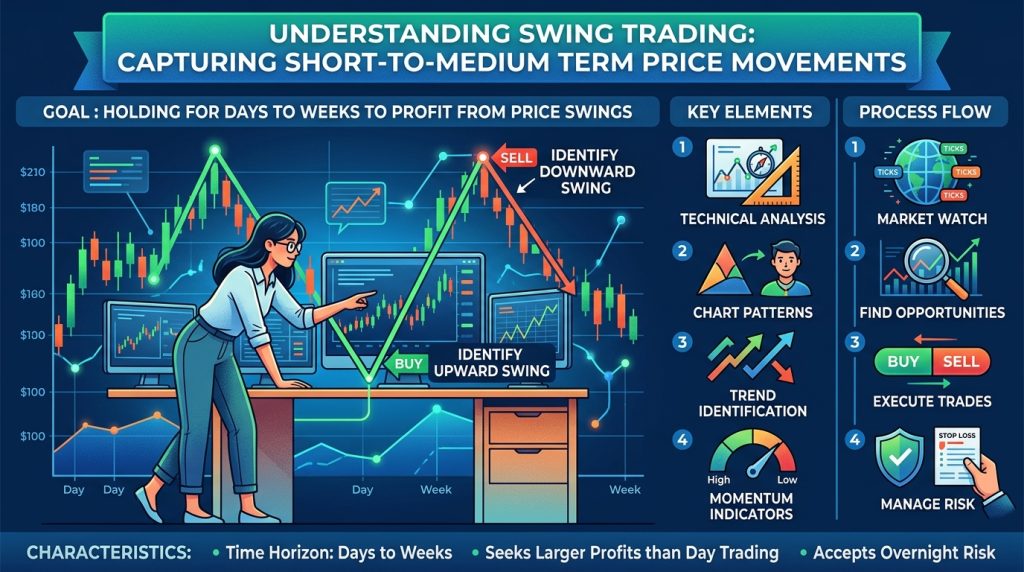
Swing trading sits in a middle zone. It is not pure investing, where cost and custody dominate everything, and it is not high-frequency day trading, where latency becomes an obsession. A swing trader usually holds positions for several days to several weeks, sometimes longer, trying to capture a directional move without sitting in front of the screen all day.
That holding period changes what a broker needs to do well. The swing trader does not need the fastest possible route to the exchange in the way a short-term scalper thinks about it. But they do need a broker with decent execution, stable platform performance, sensible charting, clean order handling, fair margin terms, and low enough costs that repeated entries and exits do not quietly eat the edge.
The wrong broker for swing trading is usually not obviously broken. It is simply misaligned. A long-term investing platform may be perfectly fine for buying an index fund once a month, yet still clumsy for managing stops, bracket orders, watchlists, and repeated trade review. A hyperactive derivatives platform may be excellent for options traders but unnecessarily expensive or chaotic for someone who mainly swings stocks and ETFs.
So the question is not really “which brand is best.” It is “which type of broker fits the way swing traders actually operate.” Once that is clear, the answer becomes much less about marketing and much more about cost structure, execution quality, and the assets you intend to trade.
This article will focus on swing trading brokers. If you want to learn more about swing trading in general then I recommend that you visit the website SwingTrading.com.
Why the “best broker” depends on what you swing trade
There is no single best broker for all swing traders because “swing trading” covers very different markets. Someone swinging U.S. stocks and ETFs needs something different from someone swinging global equities, index futures, forex, or options.
For U.S. stocks and ETFs, brokers like Fidelity and Schwab are very strong on basic pricing, platform stability, and mainstream trading tools. Fidelity offers $0 commissions on online U.S. stock, ETF, and option trades, with margin rates advertised as low as 7.50% depending on balance tiers. Schwab likewise offers $0 online trades on U.S. stocks and ETFs and $0.65 per options contract.
For multi-market swing traders, especially those who want global stocks, futures, forex, or bonds in one account, Interactive Brokers sits in a different category. It offers access to 170 global markets and emphasizes low commissions across products and broad multi-currency support.
For options-heavy swing traders, tastytrade becomes more relevant because its entire structure is built around options and futures activity, with low listed options commissions and a platform aimed at active traders. But its margin rates are not especially cheap relative to the most cost-efficient brokers, which matters for holding positions over several days.
Saxo is another case. It is not the cheapest for every domestic U.S. stock trader, but it is a serious international broker for clients who want broad market access and a polished multi-asset experience. Saxo’s published pricing also makes clear that currency conversion and other cross-market charges need to be factored in for longer-hold trades.
So the best broker depends first on the instrument. If you skip that step and choose based only on “best app” or “lowest stock commission,” you can end up with a platform that is good in general and still bad for your actual trading style.
The core features that matter most
For swing trading, the first thing that matters is execution quality. Not speed in the ultra-short-term sense, but order quality in ordinary conditions. You need a broker that handles entries, exits, stops, and limit orders cleanly. Schwab places visible weight on execution quality in its trading materials, and survey-based broker rankings continue to rate Fidelity and Schwab highly in that area.
The second thing is total cost. A swing trader may not do hundreds of trades a day, but repeated commissions, options contract fees, borrow costs, and especially margin interest can still matter. Fidelity’s public pricing page highlights $0 commissions for online U.S. stock and ETF trades and margin rates that can go as low as 7.50% at certain tiers. Interactive Brokers publishes tiered margin financing and low commission schedules across products. tastytrade is cheap on listed options commissions, but independent reviews note that its margin rates begin around 11% for smaller balances, which is less attractive for longer holding periods.
Third is platform fit. Swing traders need good charts, watchlists, alerting, basic scanning, and reliable trade management. Fidelity’s Active Trader Pro is built around charting, real-time data, and active-order management. Schwab inherited thinkorswim, which remains one of the more capable trading platforms for chart-based analysis and order flexibility.
Fourth is asset coverage. This is where Interactive Brokers and Saxo stand out. Interactive Brokers explicitly markets access to 170 markets in 40 countries and 29 currencies, which matters for traders who swing more than just domestic U.S. names. Saxo’s published materials similarly emphasize wide exchange coverage across stocks and other instruments.
Fifth is financing and overnight reality. Swing traders hold positions through time, which means borrow and financing terms matter more than they do for flat-at-close intraday traders. A broker can look cheap on trade tickets and still be expensive if margin costs are punitive.
The broker that wins for swing trading usually wins not by being dramatic, but by being efficient in all five of these areas at once.
Best overall type of broker for swing trading: a low-cost multi-asset broker with strong execution
If the question is asked in broad terms, the best type of broker for swing trading is a low-cost multi-asset broker with strong execution and sensible financing. In practice, that points most clearly to the Interactive Brokers model.
The reason is straightforward. Swing traders often evolve. They may start with U.S. stocks, then add ETFs, options, futures, or international names later. A broker that can handle that progression without forcing a platform change is structurally useful. Interactive Brokers offers low commissions across products, access to 170 global markets, and tiered margin financing, making it unusually adaptable for traders who do not want to rebuild their workflow every time their strategy broadens.
This does not mean Interactive Brokers is the easiest broker for everyone. It is not. Its platform complexity is a real issue for beginners. But swing trading is less forgiving of weak broker infrastructure than ordinary buy-and-hold investing. Once positions are being managed with stops, scaling rules, and cross-market watchlists, platform depth starts to matter more than simplicity.
The “best type” therefore is not the prettiest broker and not the most beginner-friendly broker. It is the one that combines low friction trading with institutional-style breadth and stable order handling. That is why Interactive Brokers often ends up as the best overall answer when the user has no single narrow asset class in mind. It fits the broadest version of what swing trading becomes over time.
There is also a subtler point. Swing traders live with overnight risk. That means they need a broker built for holding positions, not just firing off transactions. Margin terms, international access, and dependable infrastructure become more important than flashy onboarding. The Interactive Brokers type of broker is built around that reality.
So the best overall type is not “commission-free retail app.” It is a serious multi-asset brokerage with low costs, broad access, and good execution. Right now, the clearest example of that type remains Interactive Brokers.
Best broker types by swing-trading style
A swing trader in U.S. stocks and ETFs only does not necessarily need Interactive Brokers. If your entire focus is domestic listed equities and maybe some options, a strong full-service discount broker is often the better fit.
For that trader, Fidelity is one of the best broker types available. It offers $0 online U.S. stock and ETF commissions, competitive margin rates, no account minimums, and an active trading platform in Active Trader Pro that supports charting, screening, and real-time trade management. Fidelity also has a strong reputation for customer service and is often rated highly in broker surveys.
Schwab fits a very similar type. It is especially attractive for traders who want the thinkorswim platform inside a large, established brokerage. Schwab’s pricing is simple on U.S. listed instruments, and thinkorswim remains one of the better platforms for chart-driven swing trading, options overlays, and flexible order entry. For a trader who values platform usability and market analysis more than global reach, this is a very good fit.
For options-centric swing traders, the best type is different again. tastytrade is built around active derivatives users. Its pricing on options and futures is competitive, and its platform is oriented toward multi-leg setups, risk views, and trade management for active options traders. But it is not the cleanest choice for someone who plans to hold margin-heavy equity positions over time, because margin financing is less attractive than at lower-cost specialists.
For international equity swing traders, the best type of broker is one built explicitly for cross-border access. Saxo is a good example. It offers broad exchange coverage and a cleaner interface than some institutional-style competitors. But the trader needs to respect total cost, especially FX conversion and cross-market dealing expenses. That matters more in swing trading than many people realize because positions are opened and closed often enough for small frictions to compound.
So there are really four good answers depending on style. The broad multi-asset swing trader is best served by Interactive Brokers. The U.S. stock and ETF swing trader fits best with Fidelity or Schwab. The options-heavy swing trader fits better with tastytrade. The international equity swing trader may prefer Saxo if usability matters as much as market reach.
That is why the question should be answered by broker type first, then by brand.
What traders often get wrong when choosing a broker
The most common mistake is overvaluing commission-free marketing. Swing traders often gravitate toward “$0 trades” as if that settles the issue. It does not.
A broker can offer $0 stock commissions and still be a poor fit because the charting is weak, the order tools are clumsy, the margin rates are high, or the asset coverage is too narrow. Fidelity and Schwab make the $0 commission model work because they pair it with strong infrastructure. A random app offering the same headline price does not necessarily do that.
The second mistake is confusing beginner simplicity with long-term usefulness. A clean interface feels reassuring at first, but swing trading usually becomes more demanding over time. Watchlists grow, alerting matters more, and cross-asset ideas start to appear. A broker that feels “easy” in month one can feel cramped in year two.
The third mistake is underestimating financing. Swing traders hold positions overnight and often for weeks. That means margin and financing are not side issues. They are part of the strategy economics. Interactive Brokers publishes margin rates and financing tiers prominently for a reason. The cost of borrowed capital can quietly reshape your actual returns.
The fourth mistake is choosing a broker that fits someone else’s strategy. Social media tends to flatten everything into “best broker” rankings, but the best futures broker, best options broker, and best equity swing-trading broker can easily be three different things.
A serious answer starts with your holding period, instruments, and use of margin. Without that, broker choice becomes branding.
Cost, margin, and holding-period realities
Swing trading costs are easy to underestimate because they are usually not dramatic on a per-trade basis. They accumulate.
For stock swing traders at Fidelity and Schwab, the direct ticket cost is often minimal because online U.S. equity trades are commission-free. That is a genuine advantage. But once options are added, contract fees matter. Once margin is used, financing starts to matter more than the ticket. Fidelity advertises margin rates as low as 7.50% at certain levels, while Interactive Brokers uses a benchmark-plus structure that is often attractive for active traders who use leverage efficiently.
For options swing traders, tastytrade’s low options commission structure is appealing, especially with free closing on many positions. But that benefit should be weighed against margin terms and the fact that the platform economics are strongest for people trading options actively and in size.
For international swing traders, commissions are only one layer. FX conversion, exchange fees, and custody mechanics matter. Saxo is transparent about the fact that commissions and conversion charges are part of the package. Interactive Brokers does better than most on global market access and total-cost efficiency, which is why it remains strong for traders who regularly hold positions across currencies.
This is why the best type of broker for swing trading is one that stays cheap not only when you enter, but while you hold. A broker optimized only for zero-commission headlines can still be a costly place to run a multi-day strategy.
Final verdict
The best type of broker for swing trading is a low-cost, strong-execution broker that matches the instruments you actually hold for days or weeks, not just the ones you browse on a watchlist.
In broad terms, the best overall type is the Interactive Brokers model: multi-asset, low-friction, margin-aware, and built for traders who may need global markets, options, futures, or forex alongside stocks. Interactive Brokers is the clearest example of that category today because it combines low commissions, published margin financing, and access to 170 global markets.
If your swing trading is mostly U.S. stocks and ETFs, the best type shifts toward a full-service discount broker with strong execution and good desktop tools. Fidelity and Schwab are the best examples there. If your swing trading is mostly options, the best type shifts toward an options-first active broker like tastytrade. If you swing international equities regularly, Saxo becomes a credible alternative where broad exchange access and platform usability matter.
So the clean answer is this: for most serious swing traders, the best type of broker is not the simplest app and not the one with the loudest “free trading” banner. It is the broker that handles execution, financing, and multi-day trade management without getting in the way.
This article was last updated on: March 19, 2026
Contents