
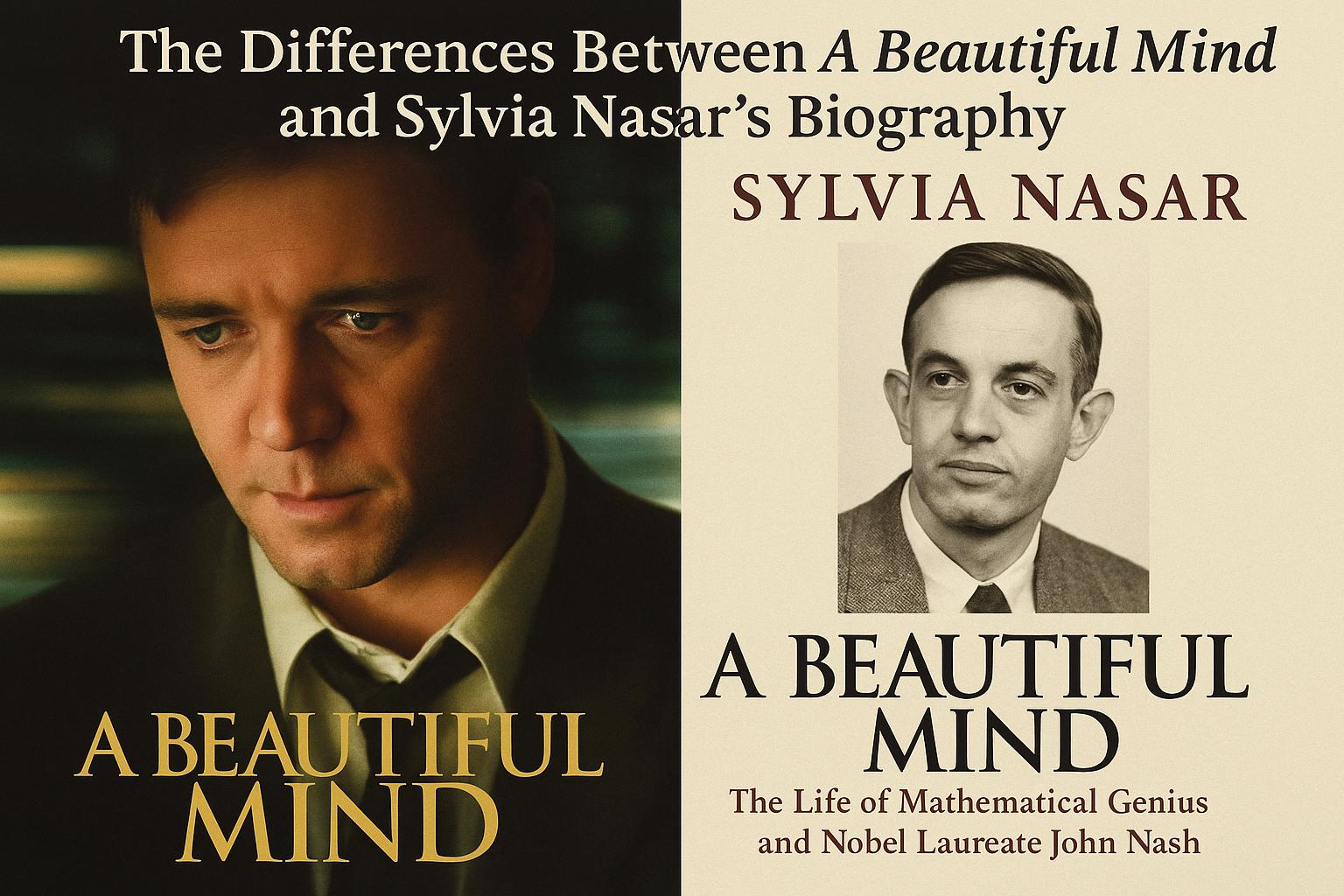
Overview
The film A Beautiful Mind and Sylvia Nasar’s biography of the same name both center on the life of mathematician John Forbes Nash Jr., yet they present his story through distinct mediums with different objectives. The biography, published in 1998, is the result of extensive archival research and interviews conducted over several years. It situates Nash within the broader historical, academic, and social contexts of the twentieth century. The 2001 film adaptation, directed by Ron Howard, translates this material into a cinematic narrative intended for a wide audience. While both works trace Nash’s intellectual achievements and his struggle with schizophrenia, they diverge in structure, tone, emphasis, and factual scope.
Nasar’s work functions as a detailed historical account. It reconstructs Nash’s early life in West Virginia, his academic development at institutions such as Carnegie Institute of Technology and Princeton University, and his groundbreaking contributions to mathematics, especially in the field of game theory. The book also examines Nash’s personal relationships, professional rivalries, and the institutional environments in which he worked. In contrast, the film concentrates on a narrower portion of Nash’s life, focusing primarily on his graduate years, his emergence as a promising scholar, the onset of his illness, and his eventual recognition with the Nobel Memorial Prize in Economic Sciences.
Differences in Content and Focus
A central distinction between the biography and the film lies in the scope of material each includes. Nasar’s biography presents a broad and meticulously documented account of Nash’s life, extending beyond his major discoveries to consider the intellectual climate of mid-twentieth-century mathematics. It examines the development of game theory in detail, explaining Nash’s equilibrium concept and its significance in economics, political science, and evolutionary theory. The text situates his contributions alongside those of contemporaries such as John von Neumann and Oskar Morgenstern, thereby offering readers a deeper understanding of the academic debates and institutional dynamics of the time.
The film simplifies this intellectual background. Mathematical concepts are referenced but not explored in depth. Equations and abstract reasoning appear visually, often symbolically, rather than analytically. This approach makes the narrative accessible to viewers without technical expertise, but it reduces the opportunity for a comprehensive explanation of Nash’s theoretical innovations. The emphasis shifts from the technical substance of his work to the broader idea of intellectual originality.
The biography also dedicates substantial space to Nash’s personal life, including aspects that the film minimizes or omits. Nasar discusses Nash’s complex interpersonal relationships, including his interactions with colleagues, his marriage to Alicia Larde, and his relationships outside that marriage. Certain elements of Nash’s life, such as his sexuality and fathering of a child outside his marriage, are documented in the biography but omitted from the film adaptation. These omissions align with the film’s goal of creating a cohesive and focused narrative rather than a comprehensive biography.
Portrayal of Mental Illness
The portrayal of schizophrenia represents another major difference. Nasar’s biography provides a detailed examination of Nash’s mental health over several decades. It traces the onset of symptoms in the late 1950s, the progression of delusional episodes, repeated hospitalizations, and the long periods during which Nash lived with persistent psychosis. Nasar draws on medical records, interviews, and firsthand accounts to present a nuanced depiction of how schizophrenia affected Nash’s professional standing, family relationships, and daily functioning. The biography does not frame his recovery as sudden or complete; rather, it describes a gradual and partial remission in later years, during which symptoms diminished but did not entirely disappear.
The film adopts a different strategy. It externalizes Nash’s delusions by depicting fictional characters who interact with him over many years. These invented figures serve as cinematic devices that allow viewers to experience events from Nash’s perspective before revealing their illusory nature. While this technique effectively communicates the subjective experience of delusion, it diverges significantly from historical fact. Several of the film’s central characters, including a roommate and government agents, are composites or inventions. In reality, Nash’s delusions were more abstract and less visually elaborate than those portrayed onscreen.
Furthermore, the film emphasizes a clear arc of deterioration followed by recovery, culminating in public recognition at the Nobel Prize ceremony. The biography presents a less linear process. Nash’s improvement is shown as uneven and influenced by social support, aging, and changes in circumstance rather than a decisive therapeutic breakthrough. By simplifying this trajectory, the film constructs a narrative that aligns with conventional dramatic structure but does not fully reflect the prolonged and ambiguous nature of chronic mental illness.
Character and Event Depictions
The range and treatment of secondary characters differ substantially between the two works. Nasar introduces a wide array of mathematicians, economists, family members, and institutional figures. These individuals are depicted with attention to their professional contributions and personal interactions with Nash. The biography explores the collaborative and competitive aspects of academic life, illustrating how recognition, reputation, and institutional politics shaped Nash’s career.
In contrast, the film condenses or merges several individuals into composite characters. This method streamlines the narrative, reduces exposition, and maintains focus on Nash as the central figure. Alicia Nash, portrayed prominently in the film, becomes the principal supporting character, representing emotional stability and continuity. While Alicia’s role was indeed significant, the film amplifies her presence to reinforce a cohesive domestic storyline.
Chronology is also adjusted in the film to enhance narrative clarity. Events are rearranged or simplified, and time spans are compressed. For example, certain professional milestones appear closer together than they were historically. These modifications are common in film adaptations but contribute to discrepancies between the cinematic narrative and documented history.
Purpose and Audience
The intended audience and purpose of each work strongly influence its structure and emphasis. Nasar’s biography addresses readers interested in intellectual history, mathematics, economics, and the sociology of science. It aims to provide a carefully researched account grounded in documentary evidence. Its tone remains analytical, offering context for Nash’s work and examining both achievements and shortcomings. The biography seeks to inform and to situate Nash within a broader scholarly tradition.
The film, by contrast, addresses a general audience and prioritizes cinematic coherence. Its objective is to present a compelling narrative centered on a gifted individual confronting personal and professional obstacles. To accomplish this, the screenplay employs dramatic devices, selective omission, and simplified explanations. While the film retains the essential outline of Nash’s life—his early promise, struggle with mental illness, and eventual recognition—it reshapes details to align with the expectations of mainstream storytelling.
Both works contribute to public understanding of John Nash, but in different ways. The biography offers depth, context, and complexity, presenting Nash as a multifaceted individual shaped by intellectual ambition, personal difficulty, and historical circumstance. The film provides a concentrated portrayal that introduces viewers to key aspects of his life while emphasizing narrative clarity. Together, they illustrate how a single life can be interpreted through distinct forms, each defined by its medium, audience, and purpose.
This article was last updated on: March 5, 2026