
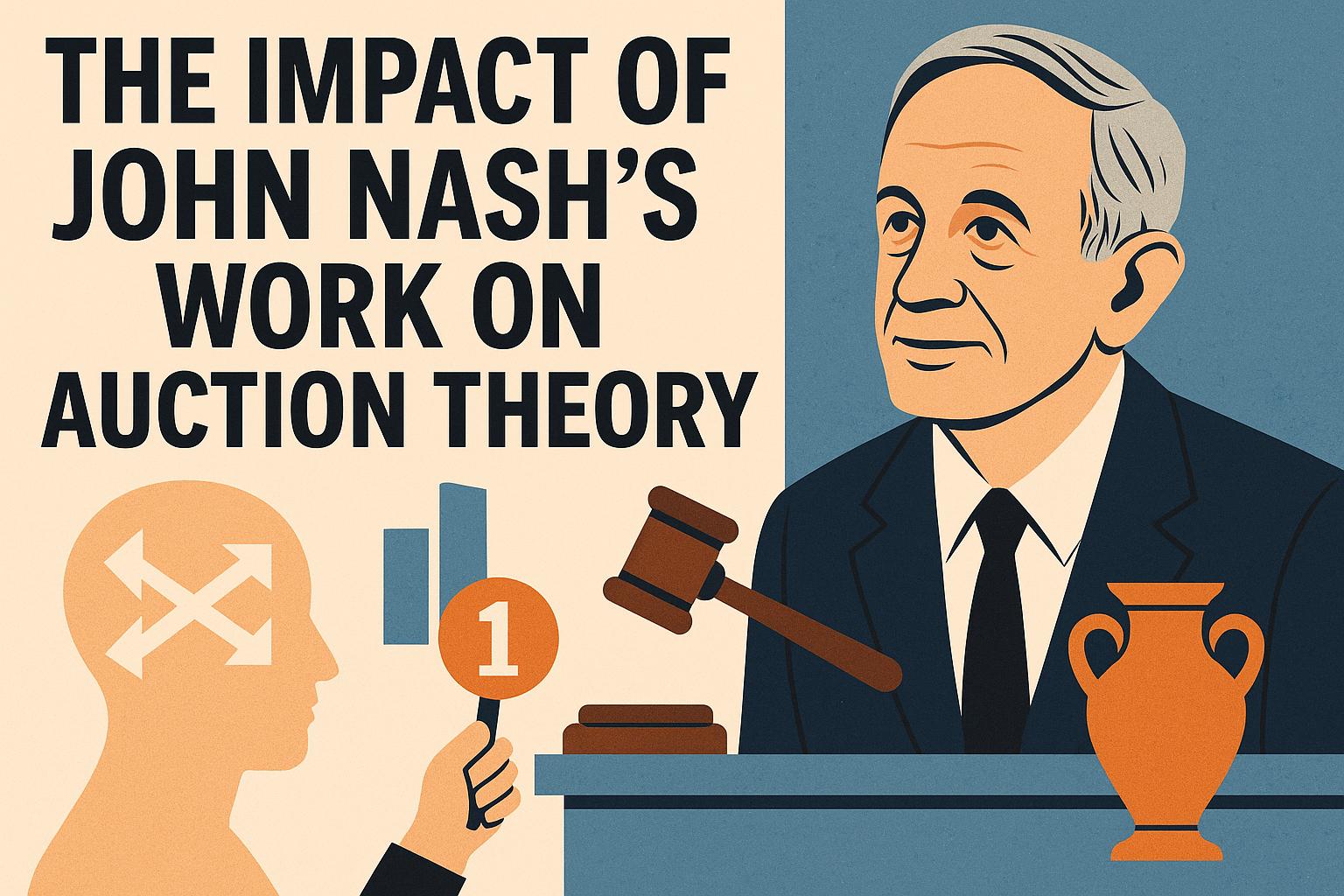
Introduction to John Nash’s Contributions
John Nash, an acclaimed American mathematician, made groundbreaking contributions to game theory which have significantly influenced several academic fields, notably economics and auction theory. Nash’s innovative ideas fundamentally changed the way strategic interactions among agents are understood, providing profound insights into the mechanisms governing auctions and markets.
The Concept of Nash Equilibrium
One of the most celebrated achievements of John Nash is the formulation of the Nash Equilibrium. In the context of game theory, a Nash Equilibrium is a state of balance where no participant can gain by changing their strategy if the strategies of all other participants remain unchanged. This concept, which emerged in the early 1950s from Nash’s pioneering work, has empowered economists to predict the outcomes of strategic interactions within competitive scenarios, such as auctions, by offering a structured method to analyze these dynamics.
Application in Auction Theory
The applicability of the Nash Equilibrium is extensive within auction theory, serving as a cornerstone for understanding bidder behavior. Auctions represent strategic games in which bidders make decisions on their bids based on accessible information and expectations regarding competitors’ strategies. Employing the Nash Equilibrium, economists can model these interactions, enabling the prediction of auction outcomes. Furthermore, they can assess the efficiency of auctions and design them to accomplish specified objectives, such as maximizing revenue or ensuring equitable conditions.
Vickrey Auctions and Nash Equilibrium
A quintessential illustration of Nash’s principles in action is found in the Vickrey auction, or the second-price sealed-bid auction. In this type of auction, bidders submit their bids privately and the highest bidder wins, paying only the amount of the second-highest bid. The distinctive feature of Vickrey auctions is that submitting a bid that matches one’s true valuation becomes a Nash Equilibrium strategy. Under this paradigm, bidders have no incentive to misrepresent their valuations, thereby leading to an efficient allocation of resources.
Impact on Auction Design and Economic Theory
The ramifications of John Nash’s work are profound in the realm of auction design. Auction organizers draw upon the principles of Nash Equilibrium to develop mechanisms that incentivize favorable outcomes. For instance, Nash’s theories guide the creation of auctions designed to deter collusion among participants, reduce bidder asymmetries, and bolster overall welfare.
Nash’s insights extend beyond auction theory to exert a significant influence on the broader spectrum of economic theory. By offering a solid analytical framework for exploring strategic interactions, Nash has enabled economists to enhance their comprehension of how strategic decisions by individuals can culminate in varied market outcomes. This advance has been pivotal in the evolution of both economic and game theory.
Further Exploration of John Nash’s Legacy
Beyond the scope of auction theory, John Nash’s contributions to game theory have wide-reaching implications. His work laid the groundwork not only for economists but also for a host of disciplines such as political science, evolutionary biology, and computer science. The Nash Equilibrium serves as a versatile tool that aids in the analysis of numerous strategic scenarios extending well beyond economics.
Applications in Economics
In economic theory, the implementation of the Nash Equilibrium has been instrumental in elucidating competitive behavior in markets. Economists employ Nash’s framework to explore various market structures, including oligopolies where a limited number of firms influence prices and production. By analyzing how firms act strategically in relation to their competitors, economists can predict market outcomes more accurately and propose regulation or policy changes to promote competitive equilibria.
Influence on Political Science
In political science, Nash Equilibrium has been applied to analyze voting behaviors, coalition formation, and legislative decision-making processes. Researchers utilize Nash’s framework to understand how political actors might process strategic choices, shaping outcomes that significantly impact governance and public policy.
Impact on Evolutionary Biology
Nash’s concepts have also been influential in the realm of evolutionary biology, particularly in understanding the evolution of species through game-theoretical models. The strategies that species evolve can be seen as equilibria in strategic games. Biologists apply these ideas to discover how cooperation and competition among species arise and stabilize in ecosystems.
Comprehensive Understanding Through Scholarly Exploration
To fully appreciate the depth and breadth of John Nash’s contributions to game theory and their profound implications across diverse fields, one might delve into scholarly research papers, books, and articles by eminent economists and game theorists. Academic databases often house invaluable resources that provide detailed explorations of Nash’s work and its far-reaching influence.
By seeking out such scholarly resources, one obtains an enriched understanding of how John Nash’s pioneering ideas continue to resonate within academia and beyond, shaping the analytical foundations of various disciplines.
This article was last updated on: January 4, 2026