
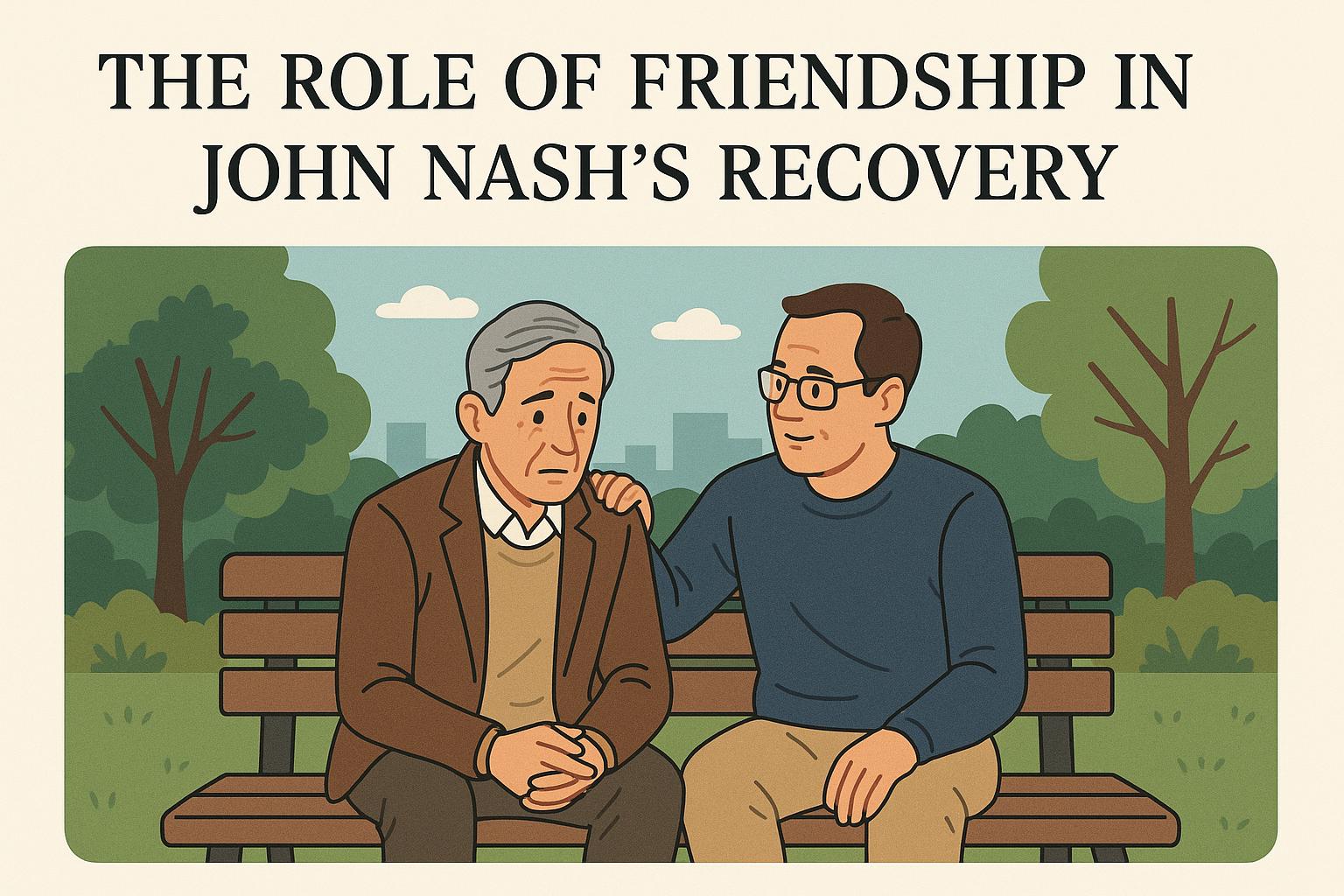
The Role of Friendship in John Nash’s Recovery
John Nash, the distinguished mathematician known for his foundational work in game theory, differential geometry, and partial differential equations, occupies a unique place in both scientific and cultural history. His intellectual achievements reshaped economics and mathematics in the twentieth century, yet his life was also marked by a prolonged struggle with paranoid schizophrenia. While medical treatment, time, and personal resilience all contributed to his gradual remission, the role of friendship was a decisive and often underexamined factor in his recovery. The sustained presence of colleagues, family members, and close companions provided stability, continuity, and a framework within which he could eventually reestablish his professional and intellectual identity.
Understanding John Nash’s Illness
In the late 1950s, at the height of his early academic promise, Nash began exhibiting symptoms consistent with paranoid schizophrenia. He developed persistent delusions, including beliefs that he was receiving coded messages and that he was involved in complex political or extraterrestrial conspiracies. These episodes disrupted his teaching responsibilities and damaged his standing within academic institutions. Hospitalizations followed, along with periods of treatment that included medication and other interventions common at the time.
The onset of his illness coincided with what might otherwise have been the most productive years of his career. As his symptoms intensified, his capacity to engage in sustained mathematical reasoning diminished. Colleagues who had once regarded him as a singular talent now encountered erratic behavior and withdrawn communication. His professional isolation increased, and his reputation risked being defined solely by his illness rather than by his earlier contributions. In this context, the persistence of friendships within the academic community became particularly important.
The Importance of Supportive Relationships
Serious mental illness can produce social withdrawal, strained communication, and distrust. These patterns tend to isolate individuals from professional networks and personal support systems. In Nash’s case, however, complete social severance did not occur. Although some relationships were disrupted, others endured. Friends and colleagues maintained a degree of respect for his intellectual achievements even when his behavior was unpredictable.
This continuity helped preserve an essential aspect of Nash’s identity: his self-conception as a mathematician. For someone whose sense of purpose was closely intertwined with abstract reasoning and discovery, the acknowledgment of his intellectual past by peers was not trivial. Even during periods when he was unable to produce new work, he was remembered for earlier theorems and insights. That recognition functioned as a bridge between his pre-illness accomplishments and the possibility of future engagement.
Moreover, supportive relationships provided informal oversight and stability. When someone experiences delusions or distorted perceptions, external reference points become important. Friends who continued to interact with Nash created opportunities for grounded conversation and routine social contact. While such interactions did not eliminate symptoms, they reduced the extent to which he was entirely isolated within his own internal world.
The Role of Colleagues
Nash’s connection to Princeton University proved especially significant. Even during decades when he was not formally employed in a traditional academic capacity, he remained a visible presence on campus. He attended lectures, walked the halls, and engaged intermittently in discussions. Rather than excluding him, many faculty members tolerated and, in some cases, quietly supported this continued association.
This institutional tolerance cannot be reduced to passive acceptance. It represented a recognition that Nash’s earlier work had permanently altered the landscape of mathematics and economics. By allowing him to remain physically present in an academic setting, Princeton provided a structured environment in which intellectual engagement was normalized. Over time, as his more acute symptoms receded, this setting made it easier for him to resume substantive conversations about research.
Colleagues also contributed by engaging Nash in mathematical dialogue without dismissiveness. Even when his thinking occasionally incorporated elements influenced by delusion, peers were able to distinguish between pathological content and genuine mathematical reasoning. This discernment preserved his dignity and reinforced the idea that his capacity for rigorous thought had not disappeared entirely. Gradual re-engagement in collaborative discussion became an informal pathway back to productive scholarship.
Family and Close Friends
Outside the university environment, Nash’s family played a central role in maintaining continuity. His wife, Alicia Nash, in particular, provided long-term practical and emotional support. Although their relationship underwent periods of strain and separation, Alicia remained involved in his life and later facilitated his return to a more stable domestic environment. Her support included managing daily responsibilities and ensuring that he had a secure place to live, factors that are often essential in stabilizing individuals with chronic mental illness.
Close friends also contributed by treating Nash as a whole person rather than as a diagnosis. This distinction is critical. When individuals are consistently defined by illness, opportunities for growth narrow. Friends who continued to discuss mathematics, current events, or everyday matters allowed Nash to participate in ordinary social exchange. Such participation reinforced routines and reduced the stigma that frequently accompanies psychiatric conditions.
Importantly, friendship did not substitute for medical care. Nash underwent various treatments, and over time he reported a gradual reduction in the intensity of his delusional thinking. However, treatment alone does not account for his sustained reintegration into academic life. A supportive interpersonal environment provided the context in which treatment effects could translate into functional recovery.
Long-term Impact of Friendship
Recovery from schizophrenia is often uneven and protracted. In Nash’s case, improvement occurred gradually over decades rather than through a single turning point. Throughout this period, the steady presence of friends and colleagues ensured that he was not required to rebuild his life from a position of complete social exclusion. When his symptoms diminished sufficiently for sustained reasoning, the infrastructure of academic relationships was already in place.
By the early 1990s, Nash had returned to active mathematical work. In 1994, he received the Nobel Prize in Economic Sciences for his contributions to game theory, specifically for what is now known as the Nash equilibrium. The award symbolized not only recognition of earlier achievements but also his restored capacity to participate in the scientific community. The friendships that endured during his illness played a substantial role in enabling this outcome. They maintained institutional memory of his contributions and affirmed his enduring identity as a scholar.
Concluding Thoughts
John Nash’s life illustrates how friendship can function as a stabilizing force during prolonged mental illness. His recovery was not solely the product of medical intervention or individual determination. It also depended on a network of colleagues, family members, and friends who preserved his connection to mathematics and to ordinary social life. By maintaining respect for his abilities and allowing continued participation in academic and personal relationships, they reduced the long-term isolating effects of schizophrenia.
The case demonstrates that supportive relationships can provide continuity, reinforce identity, and create conditions conducive to gradual rehabilitation. In environments where intellectual and social inclusion are sustained, recovery from severe mental illness can include not only symptom reduction but also meaningful reengagement with professional and communal life.
This article was last updated on: February 23, 2026