
The Role of the Windowpane Equations in A Beautiful Mind
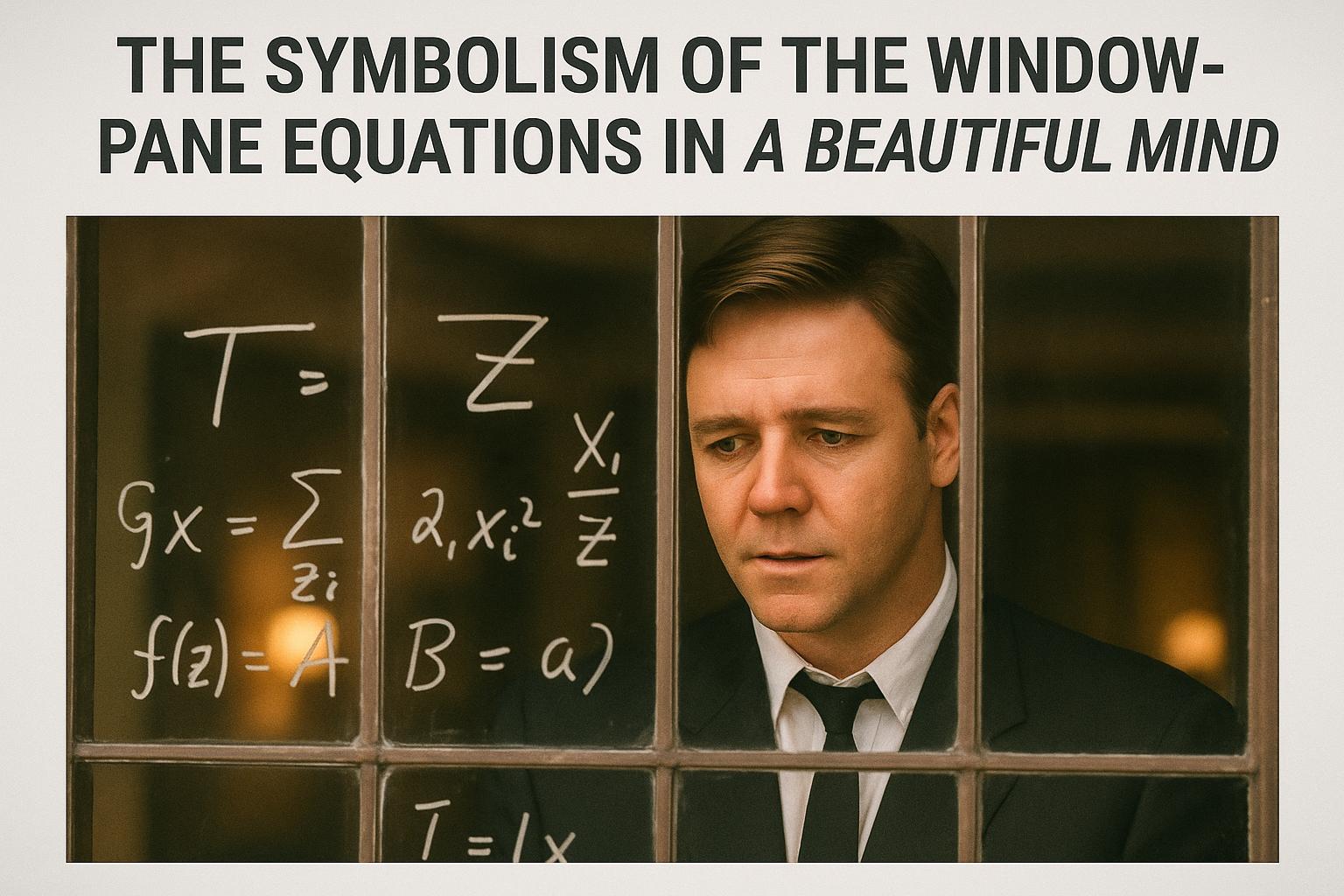
In the film A Beautiful Mind, the life and work of mathematician John Nash are translated into images that make abstract reasoning visible. One of the most recognizable visual motifs is the series of equations Nash writes across the window of his Princeton dormitory room. These markings on glass function as more than background detail. They provide a visual structure through which the audience can follow his intellectual development, his isolation, and the gradual intrusion of psychological instability. By turning mathematical thought into something observable and spatial, the film situates theoretical work within a tangible environment.
Mathematics is typically internal and symbolic, communicated through paper, blackboard, or publication. In contrast, the decision to place equations on a window elevates them into a central visual element. The light passing through the glass interacts with the textual marks, creating a layered image in which formula and world coexist. This staging reinforces the film’s central aim: to render complex ideas in a way that allows viewers to perceive them almost physically.
The Window as a Canvas for Ideas
The windowpane functions as an unconventional writing surface, distinguishing Nash from his peers. While other students rely on notebooks or chalkboards—tools associated with traditional academic practice—Nash transforms a structural element of the room into a working space. This choice visually communicates that his thinking extends beyond ordinary boundaries. It suggests a resistance to intellectual confinement and an insistence on reimagining available tools.
Writing on glass also introduces a sense of immediacy. Chalkboards are designed to be written on and erased; notebooks are meant for preservation and record. A window, however, occupies a liminal position between stability and impermanence. Marks made on it are inherently temporary and vulnerable to being wiped away. This transience mirrors the precarious nature of theoretical insight. Mathematical discovery often involves cycles of conjecture, revision, and rejection. The fragile presence of equations on glass reflects the provisional status of ideas as they are tested and refined.
The transparency of the window further enhances its metaphorical weight. As Nash writes, the outside world remains visible beyond the symbols. The coexistence of external reality and internal logic underscores the tension between engagement and withdrawal that shapes Nash’s life. He is physically present in the academic community, yet mentally absorbed in patterns that take precedence over social interaction. The glass becomes a boundary that both connects and separates.
The Reflection of Nash’s Mind
A window does not merely transmit light; it also produces reflections. When Nash stands before the glass covered in equations, his image merges with the symbols. This visual blending suggests the close identification between the mathematician and his work. His intellectual pursuits are not detached exercises but integral components of his identity. The audience sees a figure literally framed within his own abstractions.
The reflective quality of the surface also points to the theme of self-examination. Nash’s thought processes involve deep internal analysis, and the repeated image of reflection reinforces this introspective mode. At the same time, reflection can distort as well as clarify. The film gradually introduces the complications of schizophrenia, and the reflective surface becomes suggestive of the difficulty in distinguishing perception from projection. Just as reflections can appear real yet intangible, certain elements of Nash’s experience blur the boundary between objective events and subjective constructions.
The layering of equations across transparent glass parallels the layering of cognition in Nash’s mind. Complex formulas overlay the physical environment in a manner that evokes the superimposition of abstract reasoning onto daily life. The viewer is encouraged to imagine how persistent and intrusive patterns might occupy consciousness. The cinematic choice does not attempt to replicate the actual content of advanced mathematics in detail; instead, it conveys the density and intensity of continuous problem-solving.
Connection to Nash’s Personal Journey
As the narrative develops, the significance of the windowpane equations evolves. Early in the story, they represent ambition and originality. Nash seeks a governing idea, something that will distinguish him among talented peers. The visual rhythm of writing and rewriting conveys determination and concentration. The dormitory room, though modest, becomes a laboratory of thought in which new theoretical frameworks are pursued.
With the progression of his mental illness, however, writing surfaces begin to multiply and shift. Walls and other spaces appear covered with fragments of information, signaling a change in the structure of his reasoning. What initially seemed disciplined and directed starts to resemble compulsion. The contrast between the relatively ordered equations on the window and the later, more chaotic inscriptions underscores a transition from focused inquiry to fragmented perception.
The eventual reduction of such imagery toward the later stages of the film corresponds with Nash’s adaptation to his condition. Rather than presenting a dramatic elimination of symptoms, the film portrays a gradual recalibration. The symbolic disappearance of the windowpane equations emphasizes that his relationship to mathematics becomes less visually demonstrative and more internally regulated. He continues to think and contribute, but the need to externalize every line of reasoning in an expansive visual manner diminishes.
The shift also reflects a broader thematic movement from control to accommodation. Early scenes convey the impression that mastery of patterns can yield mastery of circumstance. Later developments challenge this assumption. By reducing the prominence of written glass surfaces, the film signals that intellectual brilliance does not eliminate vulnerability. Instead, Nash learns to live with uncertainty while maintaining his professional identity.
Cinematic Communication of Abstract Thought
The use of windowpane equations illustrates how cinema can translate abstract disciplines into accessible imagery. Mathematical research, particularly in game theory and advanced analysis, involves symbolic systems that are often inaccessible to general audiences. By inscribing formulas on transparent surfaces and integrating them into dynamic compositions of light and shadow, the film constructs a visual language for cognition. Viewers are not required to understand each symbol to grasp the intensity of intellectual engagement.
The repetition of this visual motif creates coherence across different phases of the story. When audiences recall the film, the image of a young mathematician writing across glass frequently stands out. This consistency strengthens the symbolic association between the window and Nash’s mental landscape. The motif remains grounded in the physical setting of Princeton while simultaneously pointing toward internal processes.
Conclusion
The equations written on the dormitory window in A Beautiful Mind operate on multiple levels. They depict creative experimentation, signify the permeability between internal thought and external reality, and trace the arc of Nash’s psychological and professional development. By choosing a window as the medium for mathematical expression, the film frames intellect as both luminous and fragile. The glass surface, transparent yet reflective, encapsulates the dual nature of Nash’s experience: clarity intertwined with distortion, insight accompanied by vulnerability. Through this recurring image, the narrative renders complex mental and mathematical processes visible, inviting sustained consideration of how innovation and instability may intersect within a single life.
This article was last updated on: February 23, 2026