
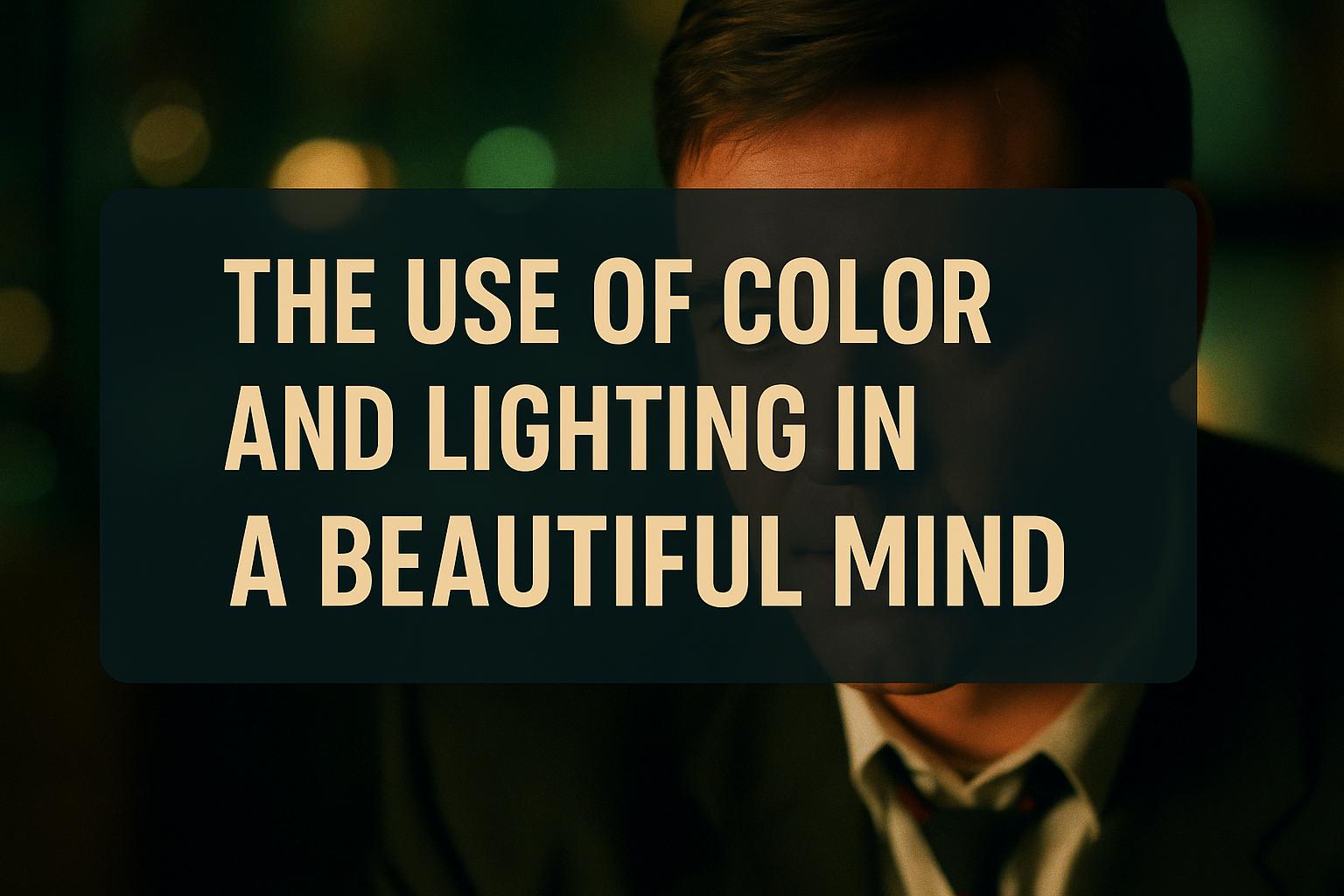
Introduction to Color and Lighting in Film
In filmmaking, color and lighting are pivotal elements that contribute to the narrative structure and thematic depth of a film. They shape the audience’s perception, establish atmosphere, and influence interpretation without relying solely on dialogue or explicit exposition. Visual design becomes a form of storytelling, guiding viewers through shifts in tone, character development, and psychological transformation. In A Beautiful Mind, directed by Ron Howard, color and lighting are carefully orchestrated to align with the protagonist’s evolving mental state and to structure the viewer’s understanding of reality and illusion.
The film recounts the life of mathematician John Nash, focusing on his intellectual achievements and his struggle with schizophrenia. Because much of the story centers on Nash’s subjective experience, the filmmakers rely heavily on visual cues. The audience is positioned to experience events largely through Nash’s perception, and the manipulation of color and light becomes essential in illustrating the instability between what is real and what is imagined.
Color Scheme and Its Implications
The color palette in A Beautiful Mind plays a crucial role in distinguishing phases of Nash’s life and gradations in his mental condition. Rather than abrupt transitions, the film employs gradual and deliberate changes in color temperature and saturation. These variations mirror Nash’s psychological shifts while maintaining visual continuity.
In the early Princeton scenes, muted tones dominate the frame. Shades of brown, beige, and subdued greens create a restrained academic environment. This palette reflects Nash’s social detachment and singular focus on intellectual achievement. The relatively low saturation and naturalistic lighting emphasize realism and austerity, reinforcing the disciplined and competitive atmosphere of the university setting.
As Nash’s academic recognition grows and he becomes more immersed in his research and imagined government assignments, subtle warmth enters the frame. Richer hues and slightly increased contrast accompany his sense of purpose and importance. The warmer tones do not appear exaggerated; instead, they quietly suggest vitality and expansion. At this stage, his delusions are integrated seamlessly into the narrative, and the color design supports their apparent plausibility.
When Nash’s mental illness intensifies, the palette gradually cools. Blues and grays become more prominent, particularly in institutional environments and private moments of confusion. The cooler tones convey sterility and psychological distance. These shifts are not purely aesthetic but function as visual markers that parallel his internal fragmentation. The careful modulation of color saturation helps differentiate periods of perceived stability from those of detachment.
Lighting Techniques to Enhance Emotion
Lighting in A Beautiful Mind is structured to distinguish between subjective and objective experience while maintaining ambiguity during critical narrative moments. Cinematographer Roger Deakins employs controlled contrasts, directional light sources, and diffusion techniques to articulate Nash’s fluctuating clarity.
Scenes that depict Nash’s delusions are often brighter than might be expected. High-key lighting and crisp highlights present hallucinated figures with apparent solidity. By lighting these imaginary characters in the same manner as real ones, the film avoids immediately signaling their unreality. This approach aligns the viewer’s perception with Nash’s, reinforcing the credibility of his experiences within the story world.
In contrast, scenes grounded in reality frequently use softer and more diffused light. Subtle shadow gradients and naturalistic illumination establish an environment that feels stable but less heightened. The difference is not one of dramatic intensity but of texture. Real-life interactions often appear gently lit, suggesting normalcy and continuity.
Low-key lighting becomes more pronounced during moments of internal conflict. Shadows partially obscure Nash’s face in several sequences, visually dividing him. This technique underscores ambiguity and fractured identity without overt symbolism. It also reflects the internal tension between rational analysis and intrusive delusion.
Institutional settings such as psychiatric facilities are depicted using cooler, more clinical lighting. Fluorescent sources, pale walls, and minimal shadow variation create an impersonal atmosphere. This lighting style contrasts with earlier academic scenes, marking a transition from intellectual aspiration to medical intervention. The visual shift reinforces the change in Nash’s circumstances while maintaining stylistic coherence.
Symbolism through Color and Lighting
Color and lighting in the film operate symbolically, though often in restrained ways. The repeated presence of gray and desaturated environments during periods of isolation underscores themes of withdrawal and psychological strain. These visual elements do not function as overt metaphors but as subtle reinforcements of mood and thematic direction.
Warmth reappears gradually as Nash learns to manage his condition and reengage with his professional and personal life. Scenes involving his wife, Alicia, often incorporate softer highlights and balanced color tones. The introduction of warmer hues during these sequences suggests relational grounding and gradual reintegration. The transition is modest rather than dramatic, reflecting the ongoing nature of his struggle rather than a definitive resolution.
The contrast between illusion and reality is also handled symbolically through consistent lighting treatment. Hallucinated characters are integrated into ordinary light conditions, emphasizing how convincingly they inhabit Nash’s perception. Only in retrospect does the viewer recognize that the visual language was intentionally neutral. This strategy reinforces a central theme of the film: the difficulty of distinguishing perception from objective truth.
Spatial lighting design further contributes to symbolism. In academic lecture halls, directional light emphasizes Nash’s position at the board, isolating him within the frame. This visual separation echoes his intellectual brilliance but also his social marginalization. In domestic spaces, lighting becomes more evenly distributed, suggesting shared presence rather than solitary focus. The distribution of light subtly mirrors the degree of connection or isolation in each setting.
Filmmaking and Psychological Insight
The integration of color and lighting in A Beautiful Mind extends beyond aesthetic preference; it provides psychological insight into the protagonist’s evolving condition. Because schizophrenia involves altered perception, the filmmakers avoid overt stylistic exaggeration. Instead, they maintain realism while embedding visual distinctions that reward attentive viewing.
By aligning visual cues with Nash’s mental state, the film encourages viewers to experience uncertainty firsthand. The minimal differentiation between delusion and reality through lighting design ensures that the audience shares Nash’s interpretive framework until narrative disclosure occurs. This choice strengthens identification with the character and demonstrates how visual storytelling can replicate subjective experience.
The gradual adjustments in color temperature and illumination also trace character development over time. Early rigidity in palette and contrast softens as Nash matures and learns to coexist with his condition. The final scenes employ balanced lighting and moderate warmth, signaling neither idealized triumph nor continued chaos, but equilibrium.
In sum, color and lighting in A Beautiful Mind function as structural components of the narrative. They delineate psychological states, support thematic exploration, and guide audience interpretation without overt exposition. Through restrained shifts in hue, contrast, and brightness, the film constructs a visual language that parallels Nash’s intellectual intensity and personal struggle. The careful orchestration of these elements demonstrates how cinematography and production design can serve as analytical tools within storytelling, providing depth and coherence to a complex biographical narrative.
This article was last updated on: April 6, 2026