
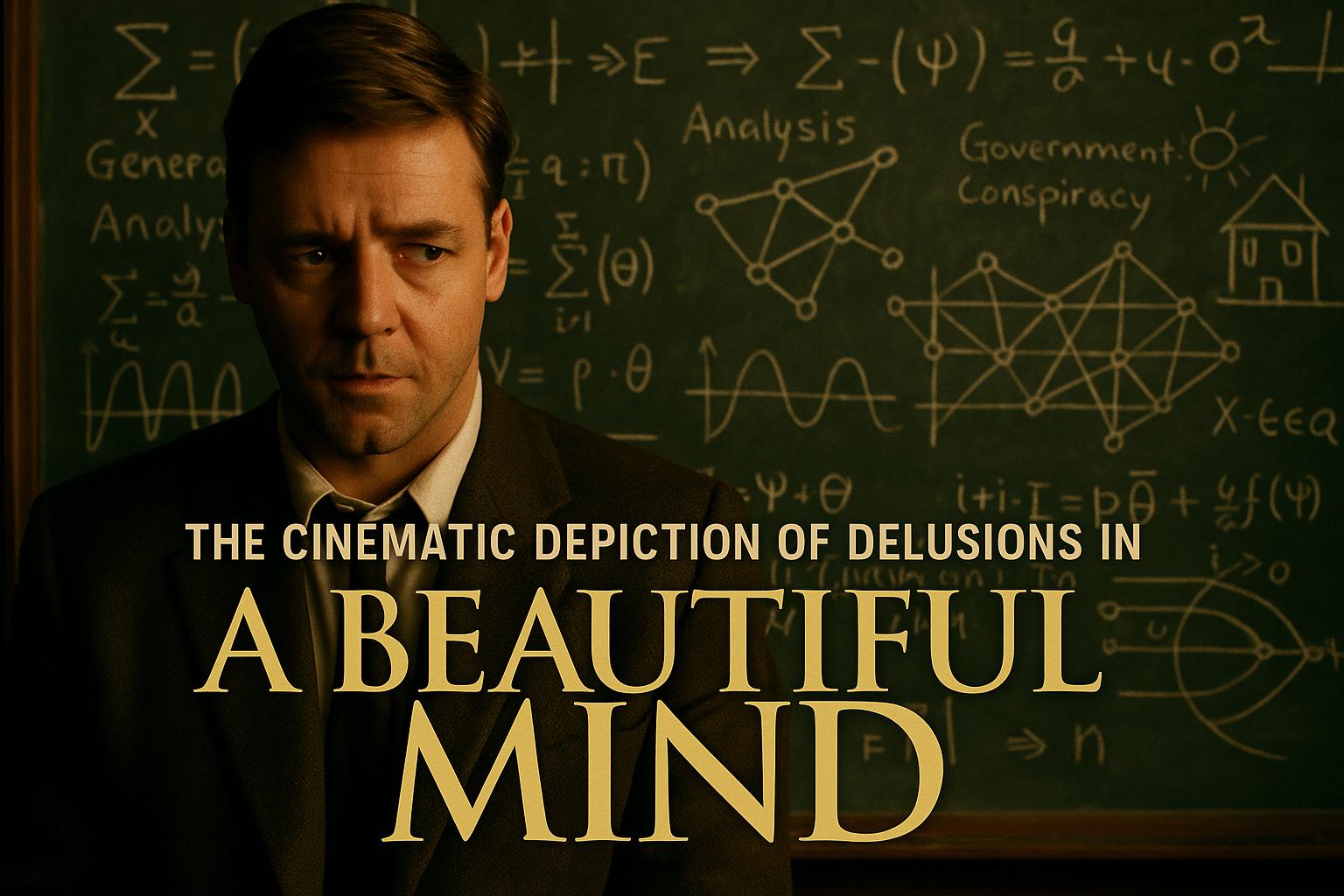
The Cinematic Depiction of Delusions in A Beautiful Mind
A Beautiful Mind, directed by Ron Howard, presents a dramatized account of the life of John Nash, a Nobel Laureate in Economics who lived with schizophrenia. The film is structured around Nash’s intellectual achievements and his evolving relationship with a mental disorder that fundamentally alters his perception of reality. Central to its narrative is the depiction of delusions, which are not presented as distant symptoms but as lived experiences integrated into the film’s visual and narrative design. The cinematic approach allows viewers to encounter these delusions from Nash’s perspective, thereby aligning audience perception with his subjective reality.
Rather than simply informing viewers that Nash experiences psychosis, the film constructs a framework in which the audience initially shares his misinterpretations. This decision shapes the dramatic structure and differentiates the film from conventional biographical narratives. The depiction of delusions becomes not only a thematic element but also a structural device that guides plot development and character relationships.
Visually Representing Delusions
The film employs visual storytelling to embed delusions seamlessly into Nash’s daily life. Characters who are later revealed to be imaginary—such as Charles, his roommate at Princeton, Charles’s niece Marcee, and William Parcher, an alleged Department of Defense agent—are introduced without stylistic markers that would immediately identify them as hallucinations. They occupy the same cinematic space as real characters, engage in extended dialogue, and interact naturally with Nash. This absence of overt visual distortion ensures that the audience accepts them as real, mirroring Nash’s acceptance.
Camera work plays a crucial role in sustaining this ambiguity. Conversations between Nash and his imagined companions are shot using conventional shot-reverse-shot techniques typically reserved for interactions between real characters. This familiar visual grammar reinforces their apparent legitimacy. Only later, when Alicia begins to question inconsistencies, does the film gradually reveal the absence of these figures from shared physical reality.
The delayed disclosure is essential. Instead of portraying delusions as fleeting or obviously distorted images, the film represents them as coherent narrative threads. Parcher’s clandestine missions and instructions to decode hidden messages in publications become a parallel storyline. This strategy underscores how delusions can integrate logically into a person’s worldview, even when they diverge from objective reality.
Cinematic Techniques
Ron Howard’s direction integrates point of view, lighting, sound design, and editing to blur distinctions between perception and reality. The dominant technique is the sustained alignment with Nash’s point of view. Much of the film’s first half is confined to what Nash sees, hears, and interprets. Viewers are not offered an external, authoritative perspective that clarifies events. This alignment builds narrative cohesion while also simulating aspects of Nash’s perceptual certainty.
Lighting subtly reinforces psychological states. Scenes involving Parcher and covert government work often feature high-contrast lighting and cooler tones, suggesting heightened alertness and tension. Interiors associated with Nash’s academic life tend to appear more neutrally lit. The variations are not exaggerated but function as atmospheric cues. They contribute to mood without signalling explicitly that certain scenes are delusional.
Sound design further intensifies subjective experience. Whispered voices, layered ambient noise, and swelling musical cues accompany moments when Nash is deciphering patterns or believes he is being pursued. The soundtrack sometimes crescendos as he focuses on numerical sequences, reinforcing the sensation that hidden structures are revealing themselves. These auditory elements do not announce a break from reality; instead, they heighten the urgency of his interpretation.
Editing choices are also significant. Cross-cutting between Nash’s lecture hall and imagined espionage assignments integrates two incompatible realities into a unified narrative flow. The visual rhythm remains consistent across both domains, preventing viewers from easily distinguishing one from the other. This formal consistency emphasizes how schizophrenia, as depicted in the film, does not necessarily fragment experience into visually chaotic episodes but can maintain an internally coherent logic.
Symbolism and Recurring Motifs
A recurring motif in the film is the pursuit of patterns. Nash’s mathematical work involves identifying governing principles within complex systems. This intellectual inclination extends into his delusional thinking. Scenes in which letters and numbers emerge visually from newspapers and magazines illustrate a symbolic merging of mathematical insight and paranoid ideation. The visual effect suggests that code-breaking becomes both a professional activity and a pathological compulsion.
The motif of windows and reflections also recurs. Nash is often framed behind glass or seen studying his own reflection. These images emphasize themes of perception and distortion. The transparent barrier of glass serves as a subtle metaphor for the thin boundary between reality and imagined constructs. Reflections suggest duplication and ambiguity, reinforcing uncertainty about what is authentic.
Another notable symbolic element is Marcee’s unchanging age. Late in the film, Nash realizes that she never grows older, a detail that exposes the fictional nature of his imagined companions. This narrative revelation is constructed around observation and reasoning rather than dramatic spectacle. The insight arises from Nash’s analytical faculties, linking his recovery to the same cognitive skills that define his professional identity.
Interpersonal Relationships
The film extends its depiction of delusions into the domain of relationships, most prominently through Nash’s marriage to Alicia. Her perspective gradually introduces an external point of reference. When she confronts discrepancies—such as the absence of Parcher in official government records—the narrative shifts toward a more objective stance. This transition marks a turning point in the audience’s understanding.
Alicia’s role is not limited to caretaker; she becomes an interpretive counterbalance to Nash’s internal logic. Their interactions demonstrate how delusions affect communication and trust. For example, Nash’s conviction that he is engaged in dangerous government work leads him to secrecy and withdrawal. These behavioral changes are portrayed without dramatic exaggeration, focusing instead on the practical consequences within domestic life.
The film also addresses institutional treatment. Nash undergoes psychiatric hospitalization and receives antipsychotic medication, which is depicted as dampening both his delusions and aspects of his cognitive vitality. His subsequent decision to manage symptoms without medication is presented as a complex and risky choice. Rather than suggesting a simple cure, the narrative shows ongoing negotiation with persistent hallucinations. In later scenes, Nash acknowledges the continued presence of imagined figures but chooses not to engage with them. This depiction frames recovery as a process of management rather than elimination.
Narrative Structure and Audience Alignment
The screenplay’s structure is crucial in shaping audience experience. By withholding information about the imaginary nature of key characters, the film constructs a shared misinterpretation. When the revelation occurs, earlier scenes are retrospectively re-evaluated. This technique encourages viewers to question their own assumptions about reliability in cinematic storytelling.
The decision to reveal the truth roughly midway through the film divides the narrative into two phases: immersion in delusion and gradual adjustment to reality. The first phase emphasizes narrative coherence within Nash’s constructed world; the second foregrounds cognitive effort and adaptation. The shift is marked not by abrupt stylistic rupture but by altered framing, in which scenes increasingly incorporate perspectives other than Nash’s.
Conclusion
The depiction of delusions in A Beautiful Mind relies on integrated cinematic strategies rather than overt visual distortion. Through sustained point-of-view alignment, restrained use of lighting and sound, symbolic motifs, and careful narrative structuring, the film presents schizophrenia as an internally coherent experience that intersects with intellectual ambition and personal relationships. By initially positioning viewers within Nash’s subjective reality, the film encourages critical reflection on perception, interpretation, and the stability of narrative authority. The result is a portrayal that situates delusions within the broader context of identity, cognition, and social connection.
This article was last updated on: April 16, 2026