
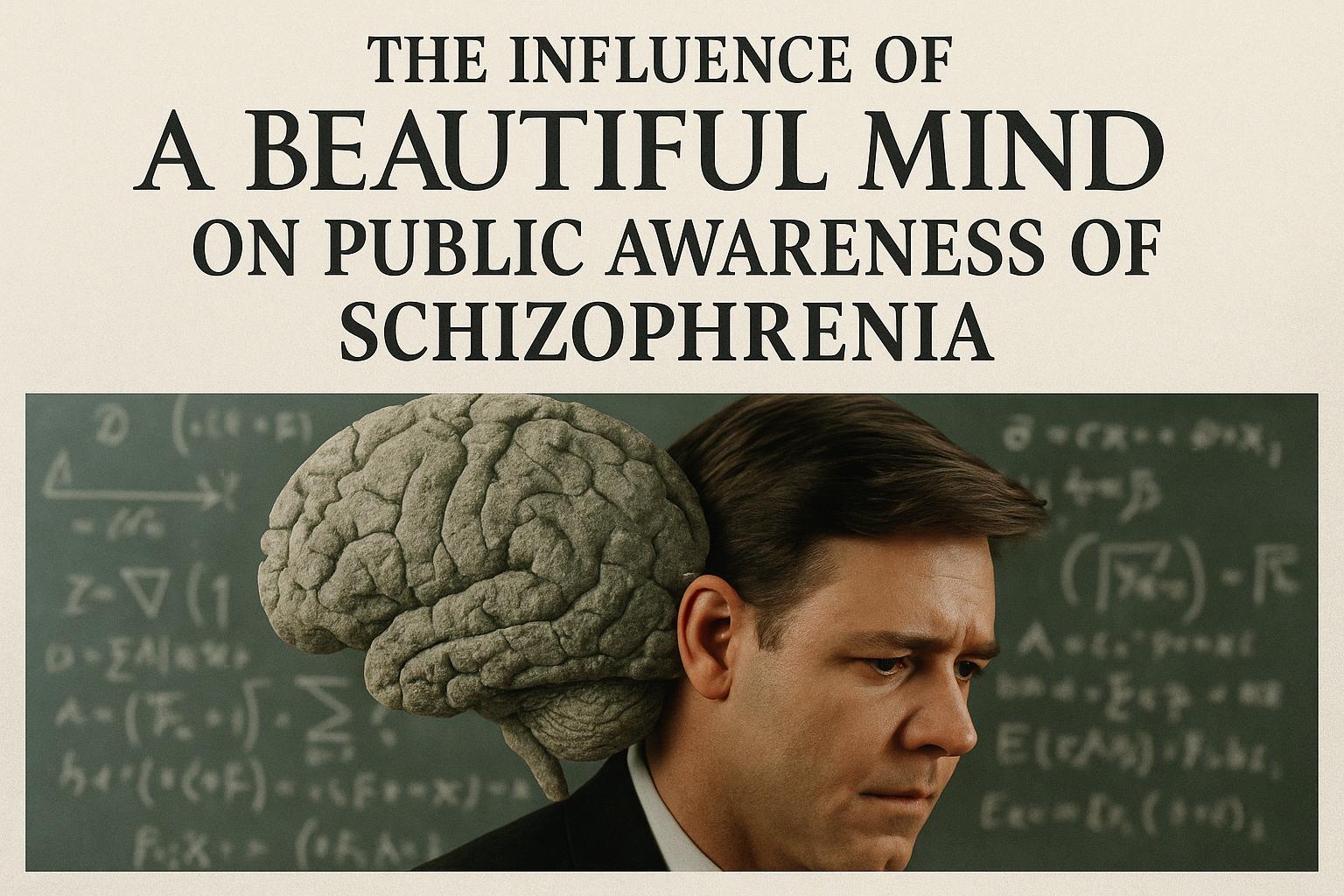
The Impact of A Beautiful Mind
The release of the film A Beautiful Mind in 2001, directed by Ron Howard, had a measurable impact on public awareness and understanding of schizophrenia. Based on the life of mathematician John Nash, the film reached a wide international audience and introduced complex issues related to mental health into mainstream cinema. At a time when schizophrenia was often misunderstood or inaccurately portrayed in popular media, the film contributed to broader public discussion and closer examination of the condition. Its commercial success and critical recognition ensured that conversations about mental illness extended beyond academic and clinical settings into public discourse.
John Nash’s Story
John Nash was a distinguished mathematician whose groundbreaking work in game theory earned him the Nobel Memorial Prize in Economic Sciences in 1994. His contributions reshaped economic modeling and influenced disciplines such as political science, evolutionary biology, and mathematics. Alongside his academic achievements, Nash experienced decades of mental health challenges associated with schizophrenia.
The film adaptation of Nash’s life presented a narrative that intertwined intellectual accomplishment with personal struggle. By focusing on both his theoretical insights and his experiences with delusions and psychiatric treatment, the film created a dual portrait of a scholar and an individual managing a long-term mental health condition. This combination of professional achievement and psychological complexity encouraged viewers to reconsider simplified assumptions about individuals diagnosed with schizophrenia.
Portrayal of Schizophrenia
A Beautiful Mind depicted several symptoms commonly associated with schizophrenia, including delusions and hallucinations. The cinematic device of presenting imagined characters as real within the narrative allowed audiences to experience the uncertainty that Nash faced. As the story unfolded, viewers gradually recognized that certain characters existed only in Nash’s perception. This approach provided a structural representation of altered reality, aligning film technique with psychological experience.
The portrayal also illustrated aspects of psychiatric treatment during the mid-twentieth century, including institutionalization and medication. While dramatized for storytelling purposes, these scenes reflected historical treatment practices that shaped many patients’ experiences during that period. By situating Nash’s condition within its historical medical context, the film offered insight into evolving psychiatric approaches.
It is important to note that schizophrenia manifests in diverse ways and may include symptoms not highlighted in the film, such as disorganized thinking or diminished emotional expression. The cinematic focus on specific visible symptoms contributed to clarity for audiences but did not encompass the full range of clinical presentations. Nevertheless, the depiction introduced many viewers to fundamental characteristics of the disorder.
Changing Perceptions
Before the release of A Beautiful Mind, portrayals of schizophrenia in mainstream film frequently emphasized danger or unpredictability. Such depictions often reinforced stereotypes and contributed to stigma. In contrast, this film centered on a highly accomplished academic figure whose intellectual capabilities remained significant despite his diagnosis. By presenting schizophrenia in the context of academic and professional life, the narrative challenged assumptions that the disorder necessarily prevents meaningful achievement.
The film’s emphasis on long-term management also contributed to changing perspectives. Rather than presenting a straightforward recovery narrative, it showed Nash developing strategies to live alongside persistent symptoms. This depiction suggested that adaptation and support systems play critical roles in long-term outcomes. The inclusion of family dynamics, particularly the role of Nash’s wife, expanded the discussion to include the broader social impact of mental illness on partners and caregivers.
Public responses indicated that audiences began discussing schizophrenia more openly following the film’s release. Media coverage often included commentary from psychiatrists and mental health advocates, who used the opportunity to clarify misconceptions and provide educational context. As a result, the film acted as a starting point for more informed dialogue.
Increased Public Interest
The commercial success of A Beautiful Mind amplified its educational reach. Winning multiple Academy Awards further increased visibility and extended its presence in cultural conversation. Interviews with cast members, the director, and mental health professionals accompanied its distribution, contributing to sustained public attention.
Mental health organizations reported increased inquiries and greater public engagement after the film’s release. Although such changes cannot be attributed to a single cultural product, the timing suggested that the film played a role in elevating interest in schizophrenia as a topic of discussion. Its accessibility allowed individuals without formal background in psychology or psychiatry to encounter the subject in a narrative framework.
By representing schizophrenia within a historical biographical film rather than a horror or crime genre, the production shifted the context in which audiences encountered the disorder. This repositioning reduced associations with violence that had characterized earlier portrayals and instead linked the condition with intellectual life and academic institutions.
Educational Opportunities
Educational institutions incorporated A Beautiful Mind into coursework in psychology, psychiatry, film studies, and ethics. In classroom settings, the film has been used to initiate discussions about diagnostic criteria, treatment evolution, patient autonomy, and the representation of mental illness in media. The narrative’s structure allows instructors to pause and analyze specific scenes, examining how cinematic technique can shape perception.
In psychology courses, students may compare the film’s depiction with clinical descriptions found in diagnostic manuals. This comparison encourages critical thinking about how artistic interpretation intersects with scientific accuracy. Film studies programs have also examined the narrative device of unreliable perception, considering how storytelling methods influence audience understanding of subjective experience.
Beyond higher education, the film has been screened in community forums and public health initiatives to prompt conversation about stigma and support systems. These discussions often emphasize the importance of early intervention, ongoing care, and community resources. Through these educational uses, the film continues to serve as a reference point in conversations about schizophrenia.
Criticisms and Limitations
Despite its contributions, A Beautiful Mind has been subject to criticism. Some observers argue that the portrayal emphasizes hallucinations to an extent not consistent with Nash’s documented experience. Historical accounts indicate that Nash primarily experienced delusions rather than persistent visual hallucinations, which were dramatized to translate abstract internal beliefs into a cinematic form. This adjustment enhanced narrative clarity but introduced potential inaccuracies.
Critics have also noted that the film simplifies aspects of treatment and recovery. The progression from acute episodes to functional stability is condensed for narrative purposes, potentially giving the impression of a more direct path than is typical. In reality, schizophrenia often involves fluctuating symptoms and extensive therapeutic intervention over many years.
Additionally, Nash’s exceptional intellectual achievement may create an implicit association between genius and mental illness. While some individuals with schizophrenia have high levels of academic or artistic ability, the majority experience more ordinary life circumstances. Presenting an extraordinary figure risks overshadowing the experiences of those whose lives do not include comparable professional recognition.
Acknowledging these limitations is important when considering the film’s educational role. Viewers should distinguish between dramatization and clinical reality, recognizing that artistic storytelling operates under different constraints than medical documentation.
Continued Influence
More than two decades after its release, A Beautiful Mind continues to influence how schizophrenia is discussed in cultural and educational contexts. The film remains frequently referenced in academic articles, public lectures, and media discussions about mental health representation. Its enduring presence demonstrates the lasting effect of widely viewed cinematic narratives on public understanding.
By portraying schizophrenia through the biography of a prominent mathematician, the film contributed to reframing the condition in public consciousness. It encouraged audiences to view individuals with schizophrenia as multidimensional people whose identities extend beyond diagnosis. Although not without inaccuracies, the film opened space for sustained dialogue about mental illness, stigma, treatment, and resilience within social systems.
The broader impact of A Beautiful Mind illustrates how cinema can shape perceptions of complex medical conditions. When widely distributed and critically recognized, a single film has the capacity to influence awareness, prompt educational initiatives, and alter the tone of societal discussion. In this respect, its significance extends beyond entertainment and into the field of public understanding of mental health.