
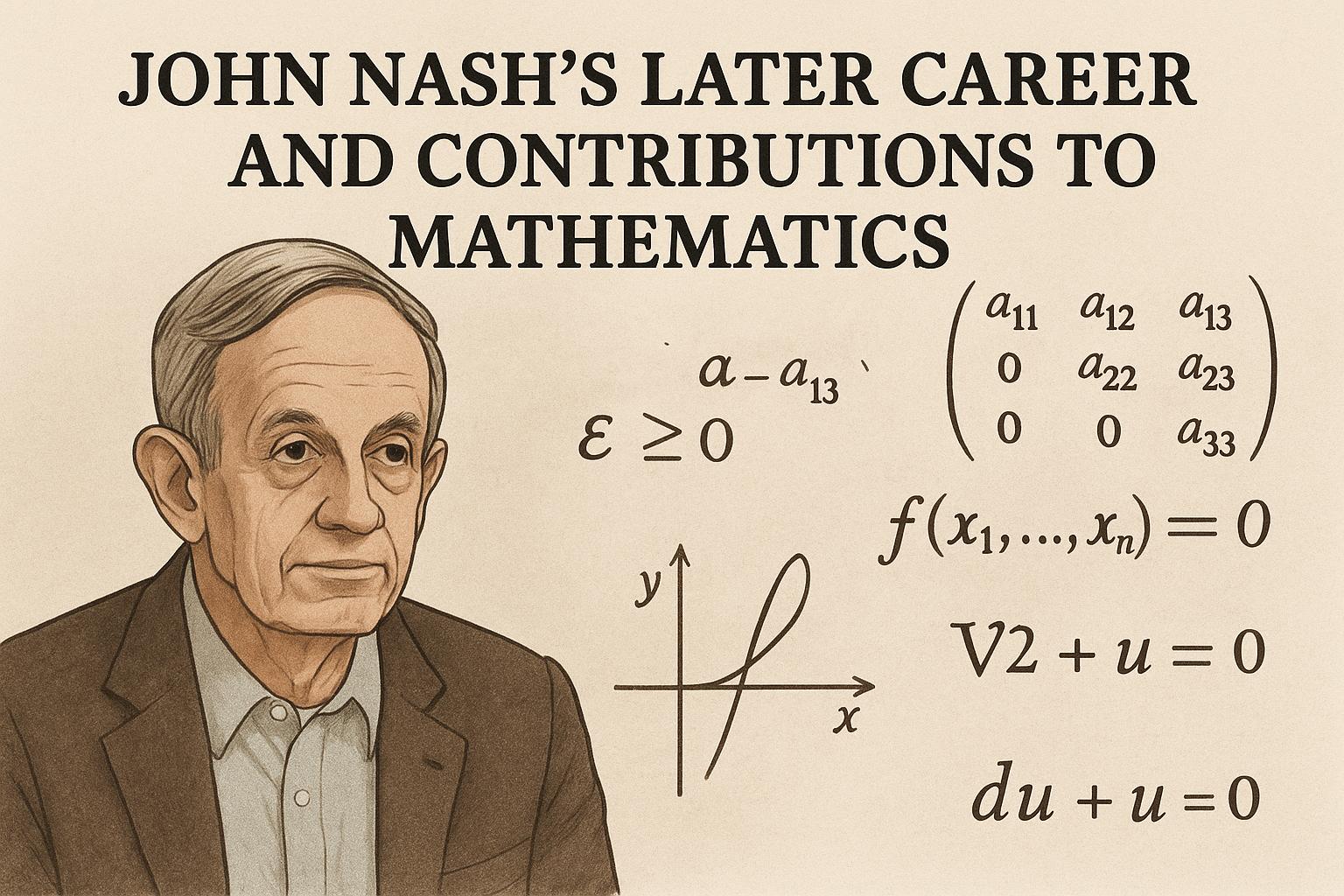
John Nash’s Later Career
John Nash’s later career unfolded over several decades following the period in which he first established his reputation as a pioneering thinker in non-cooperative game theory. Although his early work secured his place in the history of economics and mathematics, his intellectual trajectory did not remain confined to equilibrium concepts. After years marked by personal and professional interruption, Nash gradually reestablished a sustained presence in academic life. In doing so, he returned to mathematical questions that had first drawn his interest in the 1950s, while also developing new lines of inquiry that reflected his distinctive analytical style.
The award of the Nobel Prize in Economic Sciences in 1994 marked a turning point. It not only recognized his early achievements but also restored his visibility within the global academic community. This renewed recognition offered practical opportunities to participate in seminars, conferences, and collaborations. While Nash did not adopt the conventional pattern of publishing frequently or supervising large numbers of doctoral students, he engaged consistently with mathematical problems and maintained a presence at Princeton University, where he continued to think through questions that had occupied him for decades.
Post-Nobel Prize Activities
After receiving the Nobel Prize, Nash became a regular participant in academic gatherings across North America, Europe, and Asia. His talks often revisited the foundations of equilibrium theory, but they also expanded into broader topics in mathematics. Rather than limiting himself to applied economics, he reflected on structural aspects of strategic interaction, the formal properties of solution concepts, and the logical underpinnings of rational behavior in competitive settings.
In these presentations, Nash sometimes reconsidered the assumptions embedded in his earlier formulations. He expressed interest in refining equilibrium reasoning and examining conditions under which equilibrium outcomes might shift or fail to exist. These reflections did not always result in formal publications, yet they stimulated discussion among economists and mathematicians who were keen to reinterpret classical results in light of new theoretical developments.
Nash also pursued questions related to large-scale systems and global economic structures. In some lectures, he outlined ideas concerning international monetary arrangements and the strategic behavior of states within financial systems. Though these proposals were not fully developed into formal models comparable to his early work, they demonstrated his continuing interest in applying rigorous reasoning to real-world institutional problems.
Lecture Circuit
A defining feature of Nash’s later professional life was his active participation in the international lecture circuit. Invitations to speak offered him sustained interaction with diverse audiences, including mathematicians, economists, policymakers, and students. In these talks, he frequently combined historical reflection with ongoing mathematical speculation. He explained the context in which his equilibrium concept was formulated, clarified common misunderstandings, and identified directions in which he believed the theory could evolve.
These lectures also provided a platform for Nash to discuss geometry and partial differential equations, areas that had occupied him well before the Nobel Prize. Attendees often observed that his presentations retained a speculative quality. He would outline conjectures or suggest possible generalizations without necessarily presenting complete proofs. This approach reflected his longstanding preference for conceptual innovation over systematic exposition.
The lecture circuit further helped integrate Nash into contemporary mathematical discourse. Although he did not maintain a traditional research group, his presence at institutions around the world stimulated renewed interest in classical problems linked to his earlier work. For many younger scholars, these encounters provided insight into the mindset of a mathematician who approached problems from unconventional angles.
Contributions to Mathematics
While the general public identifies Nash primarily with game theory, professional mathematicians recognize that his technical contributions were distributed across several distinct areas. Even before his work on equilibrium, Nash made substantial advances in geometry and analysis. In his later years, he revisited these foundational topics, sometimes attempting to extend or reinterpret them in light of subsequent developments in mathematics.
One important aspect of his legacy concerns the interplay between analysis and geometry. Nash demonstrated early in his career that techniques from partial differential equations could be deployed to address geometric embedding problems. This theme continued to inform his thinking during his later decades, as he explored structural questions about manifolds and curvature.
Algebraic Geometry
Algebraic geometry remained an area of sustained intellectual engagement for Nash. His interest in real algebraic manifolds reflected a broader effort to understand how geometric objects defined by polynomial equations behave under various transformations. In mid-twentieth-century mathematics, the relationship between real and complex solutions to algebraic equations was an area of active inquiry, and Nash contributed ideas that influenced subsequent research on real analytic spaces.
In his later years, Nash returned to questions about how smooth manifolds can be represented by algebraic equations. The so-called Nash embedding theorem, established earlier in his career, proved that every Riemannian manifold can be isometrically embedded in some Euclidean space. This result bridged abstract geometry and concrete analytic representation. Though the theorem itself predated his Nobel recognition by decades, it continued to shape discussions in both differential and algebraic geometry, and Nash remained interested in its implications.
His engagement with algebraic geometry also extended to broader structural issues, including how singularities arise and how geometric objects can be approximated by more regular forms. Even when he did not publish formal papers, conversations with colleagues indicate that he contemplated refinements of earlier arguments and alternative proof strategies.
Riemannian Geometry
Riemannian geometry formed another central pillar of Nash’s mathematical identity. His work in this field exemplified his ability to combine geometric intuition with analytic precision. The embedding theorem, as well as his earlier contributions to nonlinear partial differential equations, demonstrated techniques that opened new pathways for research. The methods he introduced influenced later developments in geometric analysis, including work on curvature flows and global differential geometry.
In his later decades, Nash maintained an interest in the foundational aspects of geometric structures. He explored how curvature constraints interact with topological properties and how analytic methods can yield existence results for geometric configurations. Although these efforts produced fewer formal publications than his earlier period, they reinforced the conceptual connections between geometry and analysis that characterize much of modern mathematics.
The Legacy Beyond Game Theory
Assessing Nash’s later career requires distinguishing between visibility and technical output. His public prominence increased substantially after the Nobel Prize, especially with the publication of biographical accounts and the release of a major film inspired by his life. Yet within mathematics, his significance rested not on sustained publication in his later years but on the enduring influence of ideas he continued to refine and discuss.
Nash’s intellectual style remained consistent: he gravitated toward foundational problems, sought general structural principles, and favored conceptual breakthroughs over incremental refinement. His later lectures and informal exchanges preserved this orientation. By revisiting core themes in geometry and strategic reasoning, he underscored the unity of his mathematical vision.
The legacy of his later career thus lies in continuity rather than reinvention. Through lectures, discussions, and speculative proposals, Nash reaffirmed the depth and breadth of his original contributions while remaining engaged with unresolved questions. His presence in academic life after 1994 demonstrated that recognition did not conclude his creative engagement with mathematics. Instead, it provided a renewed context in which his earlier insights could interact with contemporary developments, ensuring that his influence extended well beyond the domain of game theory.