
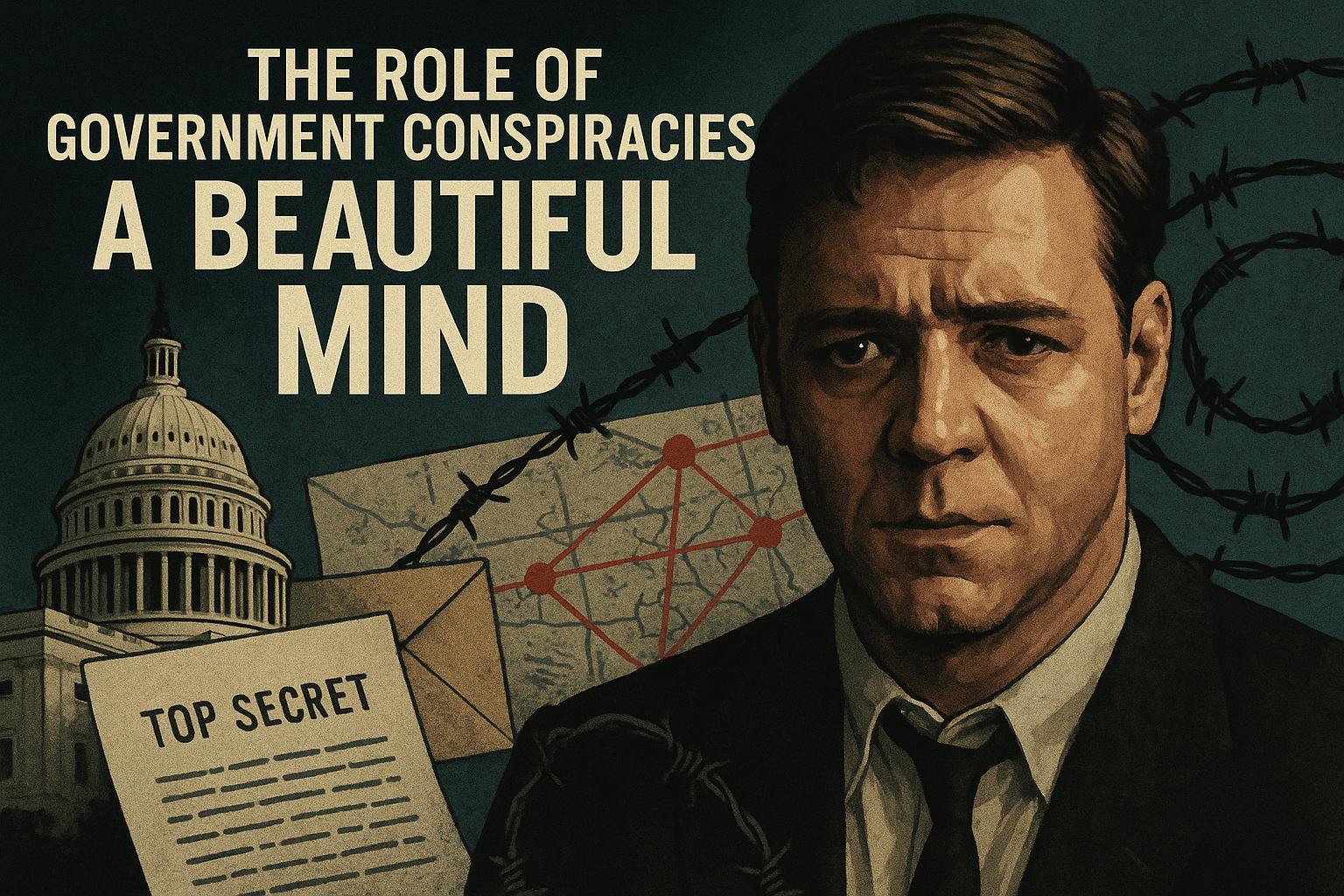
The Influence of Government Conspiracies in A Beautiful Mind
In the 2001 film A Beautiful Mind, directed by Ron Howard and inspired by the life of mathematician John Nash, government conspiracies function as a central narrative device for depicting Nash’s struggle with schizophrenia. While the film draws from real events, it incorporates fictionalized elements to translate complex psychological experiences into a cinematic form. The conspiracy storyline, particularly Nash’s belief that he is assisting the United States government in a covert operation, provides structure to the portrayal of his mental illness. Rather than serving merely as suspense, the conspiratorial framework illustrates how delusions can organize themselves into detailed, internally consistent systems that feel logical to the individual experiencing them.
The film introduces Nash as a brilliant but socially isolated graduate student at Princeton University. His intellectual focus and detachment from social norms establish a foundation for the gradual emergence of symptoms associated with schizophrenia. The government conspiracy narrative develops slowly, blending into Nash’s academic life until it becomes inseparable from his perception of reality. This progression allows viewers to experience the ambiguity between fact and delusion in a manner similar to Nash’s own perspective.
Nash’s Mental State and Conspiracy Theories
Nash’s involvement with the fictional Department of Defense agent William Parcher marks a decisive shift in the film’s tone. Parcher recruits Nash to decode encrypted messages allegedly embedded in newspapers and magazines, warning of a looming Soviet threat. These scenes are presented with no immediate indication that they are hallucinations, aligning the audience with Nash’s understanding of events. As Nash’s belief in the mission intensifies, the conspiracy expands in complexity and urgency. He perceives coded messages in ordinary patterns and becomes increasingly preoccupied with national security threats.
This portrayal aligns with documented characteristics of paranoid schizophrenia, in which individuals may develop elaborate delusional systems centered on persecution or grand missions. The film does not depict these delusions as random or chaotic. Instead, they are coherent, structured, and reinforced by recurring characters such as Parcher and Charles, Nash’s imagined roommate. The consistency of these figures contributes to their credibility within Nash’s internal logic. By embedding the conspiracy within recognizable Cold War anxieties, the film situates Nash’s delusions within a broader historical context, making them plausible within the world he inhabits.
As the narrative advances, Nash’s inability to differentiate between authentic experiences and imagined ones becomes more evident. He begins to suspect surveillance, pursuers, and hidden threats, which leads to disruptive behavior and personal consequences. The film uses these developments to demonstrate how conspiracy-based delusions can exert control over daily life, affecting professional productivity, relationships, and self-care. The government plot is therefore not incidental; it functions as the mechanism through which the film explores cognitive distortion.
Symbolism of Government Conspiracies
Beyond their narrative function, the government conspiracies in A Beautiful Mind operate as a symbolic representation of Nash’s internal conflict. The external threat of foreign agents mirrors the internal struggle within his mind. The imagined codes hidden in newspapers symbolize the search for meaning in random stimuli, a common feature in psychotic disorders known as apophenia. By transforming abstract symptoms into concrete scenarios, the film offers a visual and narrative vocabulary for understanding mental illness.
The character of William Parcher, in particular, can be interpreted as a projection of authority and validation. Through Parcher, Nash receives recognition for his intellectual abilities in the context of national security. This validation contrasts with Nash’s real-world academic challenges, where he fears inadequacy and professional obscurity. The conspiracy thus fulfills both cognitive and emotional dimensions, reinforcing the idea that delusions may incorporate elements of personal desire, anxiety, and identity.
The symbolic dimension is also apparent in the way trusted institutions are portrayed. Universities, government agencies, and even familial spaces become uncertain environments as Nash’s condition worsens. This instability reflects the breakdown of reliable reference points within his perception. The conspiracy plot enables the film to externalize this instability, presenting it through narrative conflict rather than abstract description.
Cinematic Techniques and Their Impact
The effectiveness of the conspiracy storyline is closely tied to the film’s cinematic techniques. Visual composition plays a significant role in establishing ambiguity. Early scenes involving Parcher are filmed with conventional framing and lighting, creating no visual distinction between imagined and real characters. This deliberate choice withholds cues that might signal hallucination, allowing viewers to share Nash’s interpretive framework.
As tension increases, subtle shifts in lighting and color palette emphasize unease. Government offices are often depicted with stark contrasts and shadowed corridors, reinforcing themes of secrecy and surveillance. Editing decisions, including abrupt transitions between domestic settings and covert missions, mirror the fragmentation of Nash’s experience. These techniques avoid overt spectacle, instead maintaining a controlled visual style that reflects Nash’s analytical personality.
Sound design also contributes to the portrayal of conspiracy. Background noises, subdued musical cues, and moments of silence heighten attention to seemingly minor details. The careful modulation of these elements ensures that the conspiracy narrative remains grounded rather than sensationalized. The emphasis is less on action and more on perception, aligning technical execution with thematic objectives.
Importantly, the film eventually reveals that key characters involved in the government plot are hallucinations. This disclosure reframes earlier scenes and encourages viewers to reconsider their assumptions. By structuring the revelation in this way, the film emphasizes how convincingly a delusional system can present itself, both to the individual and to observers.
The Film vs. Reality
While A Beautiful Mind conveys core aspects of John Nash’s experience with schizophrenia, it takes notable artistic liberties. There is no evidence that Nash believed he was engaged in a government espionage mission of the type depicted in the film. In reality, his delusions involved different themes and did not necessarily follow the dramatic arc presented onscreen. The fictionalization serves narrative clarity and accessibility rather than documentary accuracy.
This distinction highlights the broader challenge of portraying mental illness in cinema. Filmmakers must balance factual representation with storytelling conventions that sustain audience engagement. The introduction of a Cold War conspiracy offers a coherent storyline that can evolve toward resolution when Nash begins to question and eventually disregard his hallucinated figures. The cinematic structure thus condenses and reshapes lived experience to fit a two-hour format.
Despite these deviations, the film preserves essential truths about schizophrenia, including its chronic nature and the ongoing effort required to manage symptoms. Nash’s eventual recognition that his perceptions cannot always be trusted does not eliminate the hallucinations; instead, he learns to coexist with them while maintaining professional and personal commitments. The conspiracy narrative fades in prominence as Nash applies rational evaluation to his experiences.
Through its portrayal of government conspiracies, A Beautiful Mind provides a framework for exploring the mechanisms of delusion and the broader themes of perception and reality. The conspiratorial elements are not mere embellishments but structured representations of psychological processes. By integrating these elements with measured cinematic techniques, the film translates complex psychiatric phenomena into accessible narrative form without reducing them to caricature. The result is a depiction that, while dramatized, prompts consideration of how fragile the boundary between interpretation and misinterpretation can become under the influence of mental illness.