
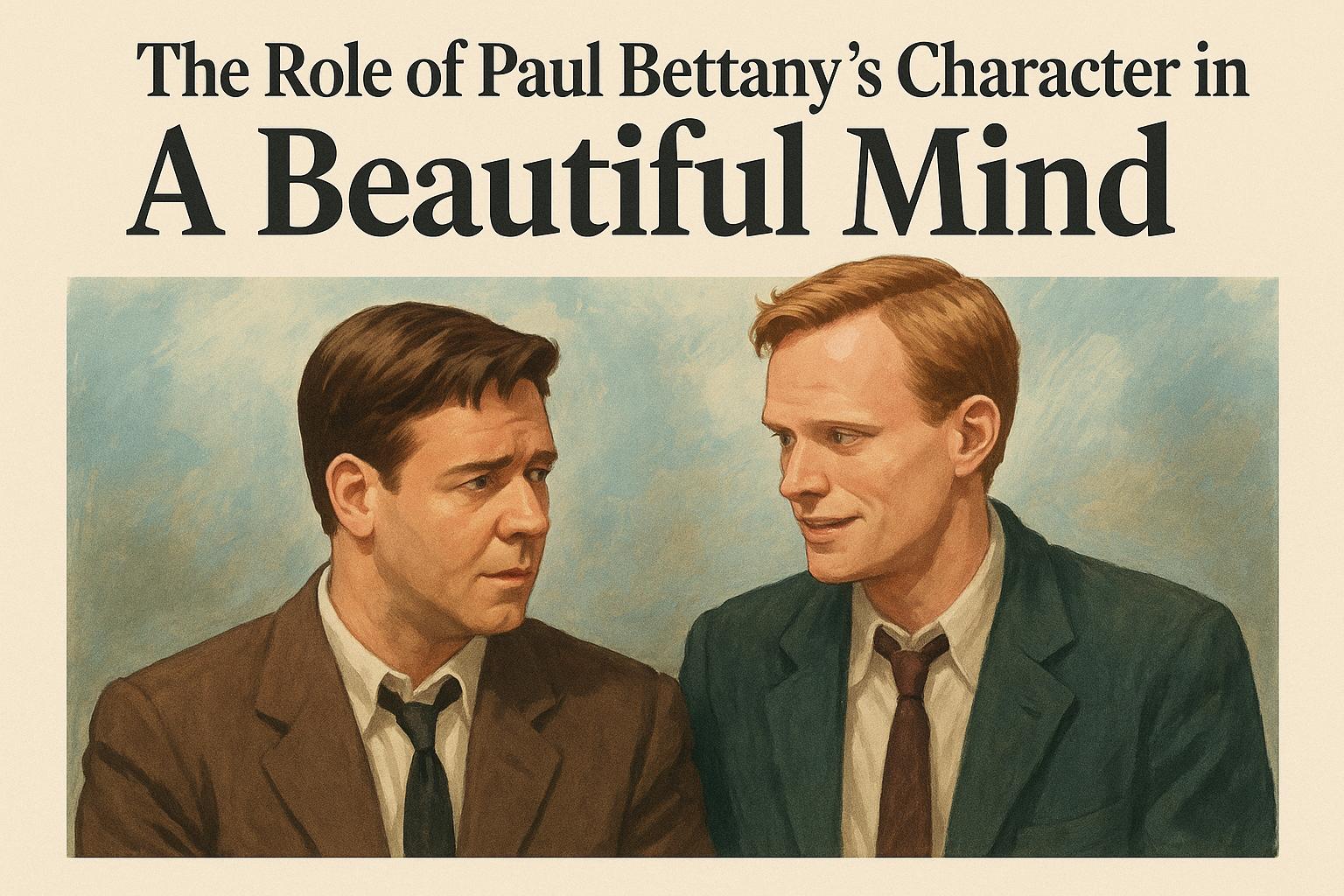
Introduction to Paul Bettany’s Role in A Beautiful Mind
Paul Bettany plays a central supporting role in the 2001 film A Beautiful Mind, directed by Ron Howard. The film presents a dramatized account of the life of mathematician John Nash, portrayed by Russell Crowe, tracing his intellectual achievements and his long-term struggle with schizophrenia. Within this narrative structure, Bettany’s character, Charles Herman, functions as both a companion to Nash and a representation of the protagonist’s psychological condition. Although Herman is not based on a real historical figure, his presence is critical to the way the film communicates Nash’s internal experiences to the audience.
The film employs Charles Herman as a narrative device that gradually reveals the boundaries between reality and delusion. Bettany’s performance supports this structure by presenting Herman as credible and consistent within the story’s world. As a result, viewers initially accept him as an ordinary character before recognizing his true nature. This technique allows the audience to experience a perspective similar to Nash’s, reinforcing the film’s broader exploration of perception and belief.
The Role of Charles Herman
Charles Herman is introduced when John Nash arrives at Princeton University as a graduate student. Nash is depicted as intellectually gifted but socially distant, more comfortable interacting with mathematical problems than with people. Herman appears as his roommate, offering an immediate contrast. He is sociable, expressive, and disinterested in academic competition. Bettany portrays Herman with a relaxed physicality and conversational tone that emphasizes his difference from Nash’s rigid and analytical demeanor.
The contrast between the two characters serves multiple purposes. On a narrative level, Herman draws Nash into social situations that Nash might otherwise avoid. He encourages him to engage with peers, attend gatherings, and consider life beyond abstract theory. On a thematic level, Herman represents traits that Nash lacks or suppresses, including spontaneity and informal social communication. Bettany’s interpretation ensures that Herman does not appear exaggerated or implausible. Instead, he is grounded enough to blend seamlessly into the academic environment portrayed in the film.
Throughout Nash’s early academic career, Herman functions as a steady presence. He listens to Nash’s frustrations about competition among graduate students and reacts with humor or reassurance. Bettany’s measured delivery keeps these interactions straightforward, avoiding overt dramatization. This restraint contributes to the later impact of the revelation that Herman is not real. Because he is portrayed as relatively ordinary, the eventual disclosure recontextualizes earlier scenes without altering their tone.
The Impact on John Nash’s Life
Within the story, Nash relies on Herman for companionship and informal guidance. Nash is shown to struggle with interpreting social cues and maintaining conventional relationships. Herman fills this gap by providing immediate and uncomplicated interaction. He praises Nash’s ambitions and offers validation when Nash doubts his progress. In this way, Herman becomes a stabilizing figure during Nash’s formative academic years.
The character’s influence extends beyond casual conversation. Herman is present during critical moments in Nash’s intellectual development, including periods of prolonged isolation while searching for an original mathematical idea. His interventions, though subtle, help sustain Nash’s motivation. Bettany portrays these interactions with consistency, reinforcing the sense that Herman is integrated into Nash’s daily routines.
As the film progresses, Herman continues to appear during key professional and personal developments, including Nash’s growing involvement with government code-breaking work. His constant availability and unwavering loyalty contrast with the increasing complexity of Nash’s life. This constancy underscores the extent to which Herman is shaped by Nash’s own psychological needs. Because Herman never challenges Nash in unpredictable ways, he reflects Nash’s internal logic rather than an independent consciousness.
The gradual shift in tone occurs when evidence accumulates that certain elements of Nash’s experiences cannot be verified. The contrast between Herman’s vivid presence and the absence of acknowledgment from other characters becomes more apparent. Bettany does not alter his performance dramatically during this transition. Instead, the stability of his characterization highlights the divide between Nash’s perception and external reality.
The Turning Point in the Film
The recognition that Charles Herman is a hallucination represents a structural turning point in A Beautiful Mind. This discovery forces both Nash and the audience to reassess prior events. Scenes that once appeared straightforward are reevaluated through a different interpretive lens. Bettany’s earlier portrayal, grounded and consistent, becomes essential to this shift because it demonstrates how convincingly the delusion was constructed.
Following the revelation, Herman does not disappear from the film. Instead, he remains visible to Nash, illustrating the persistence of hallucinations associated with schizophrenia. Bettany adapts his performance subtly during this phase. While Herman’s behavior remains consistent, the context changes. Nash now understands that the character is not real, creating a tension between recognition and perception. Bettany conveys this altered dynamic without modifying Herman’s personality, thereby emphasizing the internal nature of the struggle.
This stage of the narrative focuses on management rather than elimination of symptoms. Herman continues to appear, but Nash gradually learns to disregard him. The character’s ongoing presence reinforces the chronic aspects of Nash’s condition. Bettany’s restrained approach ensures that Herman does not dominate these later scenes. Instead, he becomes a visual representation of the choices Nash must make regarding attention and belief.
Conclusion
Paul Bettany’s role as Charles Herman is integral to the narrative design of A Beautiful Mind. Although Herman is a fictional creation within a biographical drama, his function extends beyond that of a typical supporting character. He serves as a structural mechanism that shapes the audience’s understanding of John Nash’s experiences. By presenting Herman as credible and consistent, Bettany contributes to the film’s exploration of perception, cognition, and mental illness.
The performance avoids exaggeration, relying instead on steady characterization and clear contrast with Nash’s demeanor. This approach strengthens the plausibility of the early narrative and intensifies the significance of the later revelation. Herman’s continued appearances after the turning point further underscore the film’s depiction of long-term adaptation rather than sudden transformation.
In summary, Bettany’s portrayal of Charles Herman provides insight into Nash’s internal world while supporting the broader thematic concerns of the film. The character operates as both companion and symptom, narrative device and psychological representation. Through this role, Bettany contributes to a structured and coherent portrayal of John Nash’s life, enhancing the film’s ability to communicate complex mental processes within a cinematic framework.